History of Life: Origin & Major Transitions
Overview
Evidence for Evolution established that living lineages share common ancestry; this page covers the deep history that common ancestry traces back through, how life began from non-living chemistry, how the eukaryotic cell itself originated from a merger of separate prokaryotic lineages, and how multicellularity arose independently multiple times. These are among the most heavily tested “major transition” topics precisely because each one crosses a boundary (non-life to life, prokaryote to eukaryote, single cell to multicellular) that a simple branching tree doesn’t obviously explain, and each has a specific, named body of supporting evidence.
Key Concepts
Abiogenesis and the RNA World Hypothesis
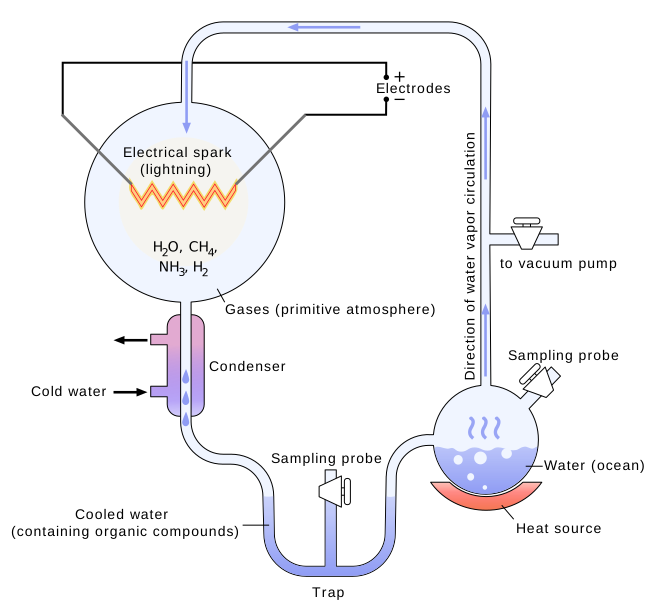
Abiogenesis is the origin of the first living systems from non-living chemical precursors on early Earth (roughly 3.5–4 billion years ago). The Miller-Urey experiment (1953) demonstrated that amino acids and other organic monomers can form spontaneously from a simulated early-Earth atmosphere (in the original experiment: methane, ammonia, hydrogen, water vapor) subjected to electrical discharge (simulating lightning), strong evidence that the building blocks of life could arise abiotically, though the experiment’s original atmospheric composition assumption is now considered a simplification of actual early-Earth conditions.
 Source: Wikipedia
The RNA world hypothesis addresses the specific “chicken-and-egg” problem of which came first, self-replicating information (historically DNA’s job) or catalysis (historically protein’s job): ribozymes (catalytic RNA molecules, discovered by Cech and Altman) demonstrate that RNA alone can both store genetic information and catalyze reactions, including, critically, catalyzing its own replication: meaning an early self-replicating system could plausibly have run on RNA alone, before DNA (a more chemically stable information-storage molecule) and proteins (more versatile catalysts) took over their respective specialized roles. The ribosome itself, a ribozyme at its catalytic core (peptide bond formation is catalyzed by rRNA, not protein), is often cited as a “molecular fossil” of this RNA-dominated stage, still functioning at the heart of protein synthesis in every living cell today.
Endosymbiotic Theory
Endosymbiotic theory (proposed by Konstantin Mereschkowski in 1905, revived and rigorously argued by Lynn Margulis in 1967) explains the origin of two key eukaryotic organelles as formerly free-living prokaryotes that were engulfed by a host cell and retained as permanent internal symbionts rather than digested: mitochondria originated from an engulfed alphaproteobacterium (aerobic, capable of oxidative phosphorylation, a major selective advantage to a host cell in an increasingly oxygenated atmosphere), and chloroplasts originated from a subsequently engulfed cyanobacterium (photosynthetic), the same primary endosymbiosis event referenced on Biosystematics’ Domains & Kingdoms page as unifying the Archaeplastida supergroup. The evidence for both organelles’ bacterial origin is specific and consistent across several independent lines:
- Double membrane: consistent with an engulfment origin (an inner membrane from the original bacterium, an outer membrane derived from the host’s engulfing vacuole/membrane).
- Own circular DNA: both organelles retain a small, circular genome resembling a bacterial chromosome in structure, distinct from and much smaller than the linear nuclear genome.
- Own 70S ribosomes, bacterial-sized (70S) rather than the eukaryotic cytoplasmic 80S ribosome, and sensitive to antibiotics (e.g. some classes that block bacterial translation) that don’t affect the host’s own cytoplasmic ribosomes.
- Binary fission: both organelles replicate by splitting in two independently of the host cell’s mitotic cycle, the same mechanism bacteria use to divide.
- Molecular phylogeny, sequencing mitochondrial and chloroplast genes and building a tree (see Molecular Systematics) consistently places them within, respectively, the alphaproteobacteria and the cyanobacteria, not as an independent lineage.


Mitochondrial acquisition is generally considered to have occurred once, in a single ancestor of all mitochondria-bearing eukaryotes (explaining why even eukaryotic lineages that have since lost or drastically reduced their mitochondria retain vestigial mitochondrial-derived organelles), while chloroplast acquisition via primary endosymbiosis is more narrowly restricted to the Archaeplastida lineage; other photosynthetic eukaryotes (e.g. some SAR-clade algae) acquired plastids instead via secondary endosymbiosis, engulfing an already-eukaryotic, chloroplast-bearing alga rather than a cyanobacterium directly, which is why some algal plastids show three or four membranes rather than two.
The Origin of Multicellularity
Multicellularity (the transition from a single free-living cell to an organism composed of many cooperating, genetically identical or clonal cells) is confirmed to have evolved independently multiple times across very different lineages (animals, plants, fungi, and several algal groups each acquired it separately), rather than being a single ancestral innovation inherited by all multicellular life. The core requirement in each independent origin is the same: cells that would otherwise be capable of independent reproduction must instead cooperate, dividing labor (e.g. some cells specializing in reproduction while others do not) and suppressing the fitness advantage any single “cheating” cell might otherwise gain by reproducing selfishly at the group’s expense, a problem directly analogous to the within-group cheater problem discussed for kin selection and eusociality in social insects, except resolved at the level of cells within one body rather than individuals within a colony. Volvocine algae (a lineage ranging from the single-celled Chlamydomonas through colonial Gonium and Pandorina to the fully differentiated multicellular Volvox, with distinct somatic and reproductive cell types) are a heavily studied case specifically because the lineage preserves living examples at multiple points along the transition, rather than requiring inference from extinct intermediates alone.

The Geologic Timescale’s Major Biological Milestones
The geologic timescale (dated by radiometric methods, most commonly measuring the decay of a radioactive parent isotope to a stable daughter isotope with a known half-life) provides the absolute dates that anchor every transition above and every phylogeny’s branch lengths (see the molecular clock discussion in Molecular Systematics). Key milestones worth holding in sequence: first prokaryotic life (~3.5 billion years ago (bya), evidenced by stromatolites, layered sedimentary structures built by cyanobacterial mats); the Great Oxidation Event (~2.4 bya, atmospheric oxygen accumulation from cyanobacterial photosynthesis, which both enabled aerobic mitochondrial metabolism and was toxic to many contemporary anaerobic lineages); first eukaryotes (~1.8–2 bya, following mitochondrial endosymbiosis); the Cambrian explosion (~541 million years ago (mya), a geologically rapid diversification of nearly all major extant animal phyla’s body plans, discussed further in Macroevolutionary Patterns & Mass Extinctions); and the first land plants and animals (~470–430 mya).

Comparative Structures
| Transition | Key mechanism | Primary evidence | Number of independent origins |
|---|---|---|---|
| Non-life → first life | Abiogenesis, RNA world | Miller-Urey synthesis, ribozyme catalysis | One (by definition, the origin of the single common ancestor) |
| Prokaryote → eukaryote (mitochondria) | Endosymbiosis of an alphaproteobacterium | Double membrane, own circular DNA, 70S ribosomes, binary fission | One |
| Origin of chloroplasts (Archaeplastida) | Primary endosymbiosis of a cyanobacterium | Same organelle evidence as mitochondria | One (primary); additional independent secondary endosymbioses elsewhere |
| Single cell → multicellular | Division of labor, suppression of cheater cells | Living volvocine algal series (Chlamydomonas → Volvox) | Multiple (animals, plants, fungi, several algal groups independently) |
Common Exam Questions
- “List three independent lines of structural/molecular evidence supporting the endosymbiotic origin of mitochondria.”
- “Explain how the ribozyme activity of the ribosome supports the RNA world hypothesis.”
- “Distinguish primary from secondary endosymbiosis, and explain why some algal chloroplasts have more than two surrounding membranes.”
- “Explain why the volvocine algal lineage is considered strong evidence for how multicellularity can evolve, compared to relying on extinct fossil intermediates alone.”
- “Explain why the Great Oxidation Event is linked to the later evolution of mitochondria-bearing eukaryotic cells.”
- “Explain what problem a newly multicellular lineage must solve regarding individual cells that could reproduce selfishly, and how this parallels the cheater problem in eusocial insect colonies.”
Visual Reference
Interactive
- Endosymbiosis evidence checklist tool (HTML/JS, no new library), the s is presented with an unlabeled organelle and a set of candidate evidence lines (membrane count, DNA shape, ribosome size, division mechanism), checking off which apply to build up the case for bacterial origin piece by piece rather than being told the conclusion first.
- Geologic timescale explorer (interactive SVG/JS, horizontal timeline), a zoomable/scrollable timeline from 4 bya to present, with clickable milestone markers (first life, Great Oxidation Event, first eukaryotes, Cambrian explosion, first land life) each revealing the dating method and key evidence for that milestone.
Static (placed inline in Key Concepts above, next to the concept each one illustrates, rather than collected here)
Practice Problems
- A researcher finds that a candidate organelle has its own 70S ribosomes, replicates by binary fission independent of the host cell cycle, and has a circular genome. Explain what these three observations together support.
- Explain why the RNA world hypothesis proposes RNA, rather than DNA or protein, as the first hereditary/catalytic molecule.
- A newly examined algal chloroplast is surrounded by four membranes rather than two. Propose an explanation consistent with endosymbiotic theory.
- Using the volvocine algae as a model, describe the specific cellular change (in terms of division of labor) that separates a truly multicellular organism like Volvox from a simple colonial aggregate like Gonium.
- Explain why the Cambrian explosion is dated using radiometric methods rather than relative stratigraphic position alone, and what a “half-life” measurement contributes to that date.