Q61 - RNA Virus Replication Cycles - Genome Classification
Based on the structure of their genome and specific features of the replication process, RNA viruses are divided into the following groups:
- Single-strand (+) RNA viruses
- Single-strand (-) RNA viruses
- Double-strand (+-) RNA viruses
- Retroid viruses (including retroviruses)
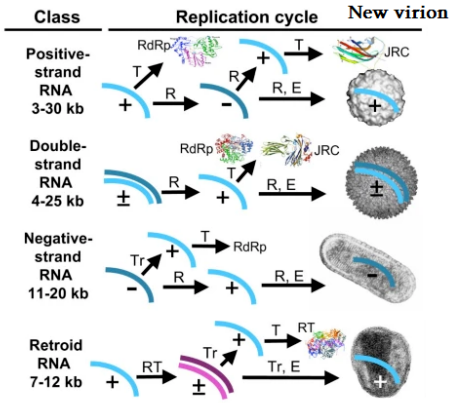 Figure. Replication cycles of positive-strand, double-strand, negative-strand, and retroid RNA viruses.
Determine whether the following statements are true or false:
A. The genome of (+)RNA viruses encodes many proteins, including the RNA-dependent RNA-polymerase
B. In all RNA-containing viruses, the RNA-dependent RNA-polymerase enters the target cell with RNA.
C. During the replication process of double-strand (+-) RNA viruses, the single-stranded (+) RNA molecules synthesized in the target cells ensure viral protein synthesis by the host cell's ribosomes and serve as a template for the synthesis of (-) RNA chains with the participation of viral RNA polymerase.
D. The genome of retroviruses encodes the reverse transcriptase enzyme, which is included in the viral particle and ensures the synthesis of DNA from viral RNA upon infection.
Question reproduced from IBO 2022, Theoretical Paper 2, licensed under CC BY-NC-SA 4.0 - attributed to the International Biology Olympiad. Open the full exam PDF · Community solutions (unofficial)