Skip to content
📢We are still a growing community and would love some help. Want to contribute? Join us by mailing an e-mail of interest to "r6394175@gmail.com"
Start helping our community →
← Theoretical 2

Q72 — Mechanisms of Synaptic Specificity

Theoretical 2 Real exam question — full text reproduced under IBO's CC BY-NC-SA 4.0 license

Neurons interact with each other to form the complex circuits that underlie brain function. This process is conventionally divided into three steps: (1) axons find their way to appropriate target areas (axon guidance), (2) they choose appropriate synaptic partners within those areas (synaptic specificity), and (3) functional synapses are formed (synaptogenesis).
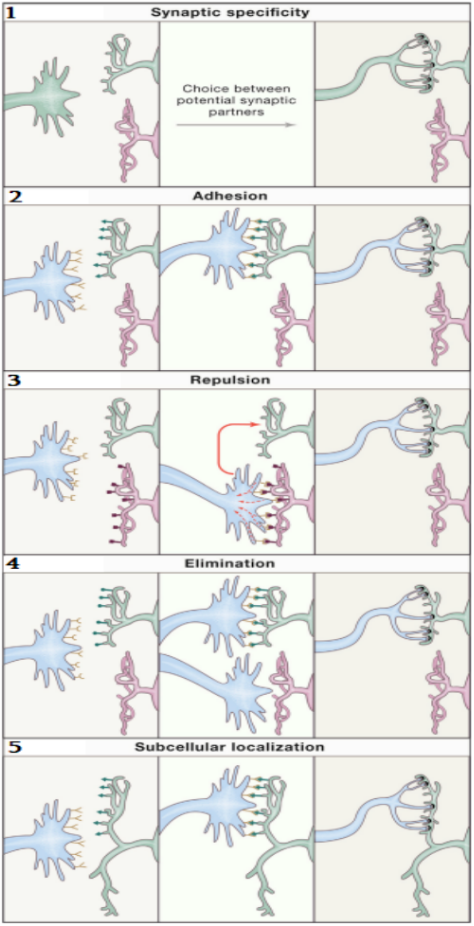
Five-panel diagram of mechanisms of synaptic specificity. Panel 1: an axon faces a choice between several potential synaptic partners. Panel 2 (Adhesion): matching cell-recognition proteins on the axon and one dendrite bind and adhere. Panel 3 (Repulsion): a mismatched partner is actively repelled away. Panel 4 (Elimination): an initially formed but non-functional connection is retracted/eliminated. Panel 5 (Subcellular localization): the axon terminal restricts its branching to one narrow stratum within the dendritic target field rather than spreading across the whole target area. Figure. Mechanisms of synaptic specificity: choice between potential partners, adhesion, repulsion, elimination, and subcellular localization.

Use the information and the figure to determine whether the following statements are true or false.

A. One neuron type has cell recognition proteins, which bind selectively to receptors on the surface of postsynaptic cells; recognition leads to an adhesive interaction which facilitates or blocks synapse formation between appropriate partners.
B. In traumatic brain injuries, cell adhesion molecules direct cellular processes that inhibit post-traumatic neuronal plasticity during recovery.
C. Synaptic connections could rewire as a result of suboptimal functionality of the original connection.
D. In many regions of the nervous system, axons or dendrites branch in just one or a few of several narrow, parallel strata within a target area.

Question reproduced from IBO 2022, Theoretical Paper 2, licensed under CC BY-NC-SA 4.0 — attributed to the International Biology Olympiad. Open the full exam PDF · Community solutions (unofficial)