Q83 - Gut Microbiome and Lifespan in Drosophila
Researchers investigated the effect of the microbiome on the lifespan of the fruit fly (D. melanogaster). To this end, they disinfected fly eggs and transferred them to a sterile food substrate. The non-disinfected eggs served as a control group (“non-axenic”, figure A). Another cohort of the flies (originating from disinfected eggs) was kept on a sterile substrate for the entire lifespan (“axenic”, figures A and B). The rest of the eggs were separated into three groups. They were treated with bacterial cultures either as embryos right after disinfection (figures B, C, D), at day 2 of adulthood (figure D) or at day 7 of adulthood (figure C). The researchers evaluated the fraction of individuals still alive in each population for 100 days, summarizing their results in the graphs below. The percentage in square brackets shows the difference in average lifespan between two populations.
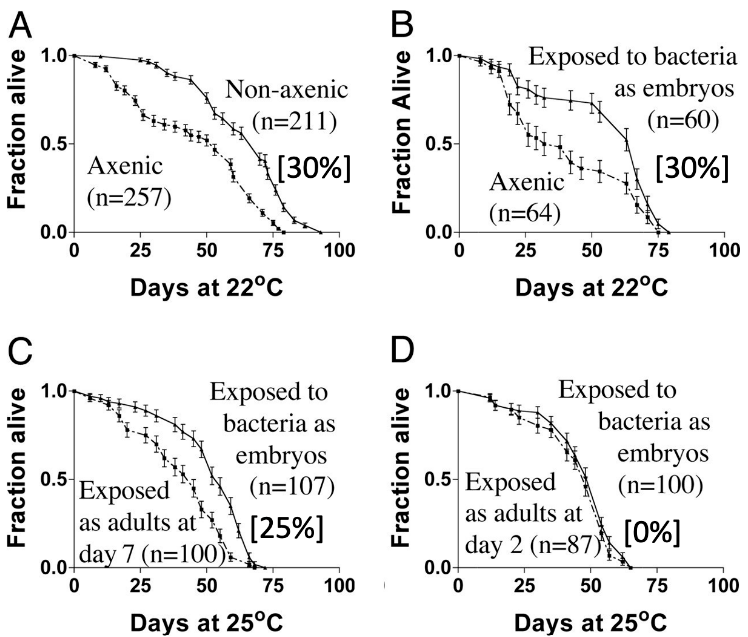 Survival curves (fraction alive vs. days) for axenic, non-axenic, and bacteria-exposed Drosophila populations, exposed to bacteria at different developmental stages.
Using the information and the data in the figures above, determine which of the statements are true or which are false.
Question reproduced from IBO 2022, Theoretical Paper 2, licensed under CC BY-NC-SA 4.0 - attributed to the International Biology Olympiad. Open the full exam PDF · Community solutions (unofficial)