Q87 - Rearing Environment and Social Bonds in Ravens
To investigate the social behavior among ravens (Corvus corax), young individuals were divided into three groups. In Group A, all individuals came from four different families raised by their parents (“parent-raised”). In Group C all individuals came from a mixed population raised by a human (“hand-raised”). In Group B, some individuals came from the human-raised population and some from a raven family (“parent-raised and hand-raised”). The strength of social relationships was measured during various seasons and shown on a graph.
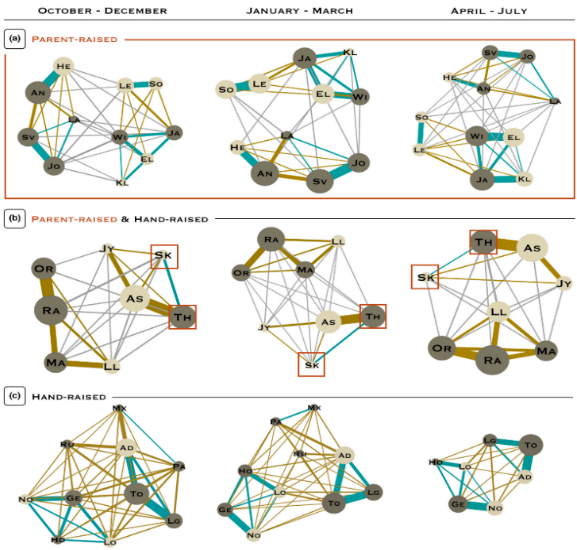 Figure 1. Relationships between individuals (October–July). Male (dark-gray node), female (light-gray node), with bigger nodes for more sociable individuals. Two-letter combinations in the nodes are IDs of individual ravens. In the mixed group B, parent-raised individuals are marked with a red square. The relationship strength (“friendliness”) between a pair of individuals corresponds to the thickness of the edge between their nodes, with blue for siblings, brown for individuals raised together from hatching, and gray for newly acquainted individuals.
Using the information and the figures above, determine which of the statements are true or which are false.
Question reproduced from IBO 2022, Theoretical Paper 2, licensed under CC BY-NC-SA 4.0 - attributed to the International Biology Olympiad. Open the full exam PDF · Community solutions (unofficial)