Skip to content
📢We are still a growing community and would love some help. Want to contribute? Join us by mailing an e-mail of interest to "r6394175@gmail.com"
Start helping our community →
← Theoretical 2

Q54 — NAD(P)H Fluorescence During the Aerobic–Anaerobic Transition in Yeast

Theoretical 2 Real exam question — full text reproduced under IBO's CC BY-NC-SA 4.0 license

The metabolic activity of microbial cells can be measured based on the intracellular content of different molecules, such as NAD(P)H, the reduced form of nicotinamide adenine dinucleotide (phosphate), which fluoresces at λ = 440 nm. A sharp increase in fluorescence intensity of NAD(P)H is observed during a forced transition of yeast cells from aerobic to anaerobic conditions (AA transition) (Figure). The relative fluorescence increase (ΔFI) during AA transition was evaluated as a measure of yeast metabolic activity.
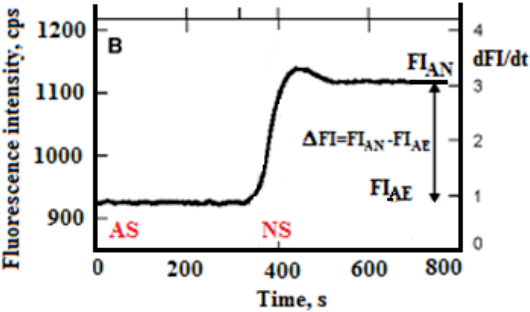
Figure. NAD(P)H fluorescence intensity during the aerobic-anaerobic transition. FI = fluorescence intensity, AS = air sparging (bubbling of air), NS = nitrogen sparging. FI_AN = fluorescence intensity during the anaerobic phase, FI_AE = fluorescence intensity during the aerobic phase. Figure. NAD(P)H fluorescence intensity during the aerobic-anaerobic transition.

Determine whether the following statements are true or false:

A. The reduced phosphorylated (NADPH) and nonphosphorylated (NADH) pyridine nucleotides have essentially equivalent fluorescence properties while their oxidized forms are non-fluorescent.
B. Under aerobic conditions, the oxidized nucleotides in cells are reduced, e.g., in the respiratory chain, which leads to an equilibrium between the formation and depletion of NAD(P)H.
C. After the sudden alteration from aerobic to anaerobic conditions (AA transition), the microbes are not able to re-oxidize all the reduced NAD(P)H, which can be tracked as an intracellular step-like increase of NAD(P)H fluorescence intensity.
D. Measurements of NAD(P)H fluorescence intensity during AA transition can indicate the increasing metabolic activity of microbes under stress conditions.

Question reproduced from IBO 2022, Theoretical Paper 2, licensed under CC BY-NC-SA 4.0 — attributed to the International Biology Olympiad. Open the full exam PDF · Community solutions (unofficial)