Q53 - Telomerase - Mechanism of Telomere Extension
At the ends of chromosomal DNA molecules of eukaryotes, there are special nucleotide sequences called telomeres, which shorten during each division of the somatic cell. Telomeres do not contain genes, but consist of multiple repeats of a short nucleotide sequence, such as TTAGGG. When DNA replication is completed (Fig. 1a), a single-strand protrusion (TTAGGG) occurs at the 3’ end of the 5’-3’ (lagging) strand of DNA. The enzyme telomerase containing the CAAUCC sequence in associated RNA allows for a complete duplicate of the DNA molecule along the entire length of the chromosome (Fig. 1b-e).
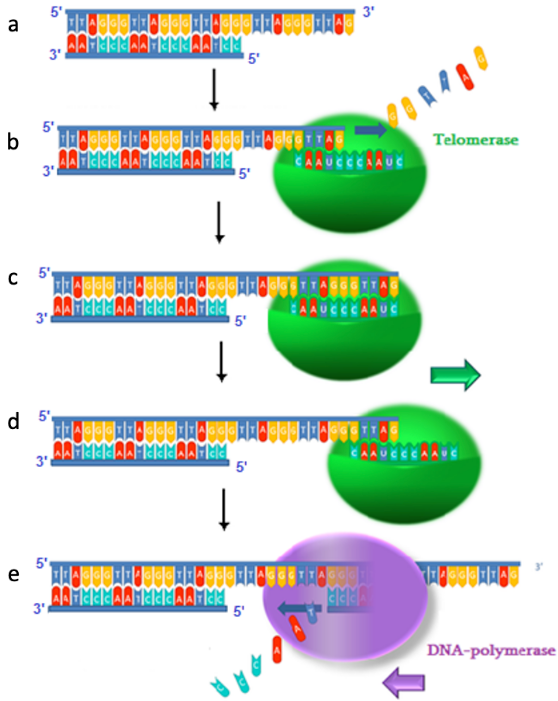 Figure 1. The mechanism of action of telomerase. 5’-3’ is the “maternal” DNA strand, and 3’-5’ is the “daughter” strand.
Using the information and figures, determine whether the following statements are true or false.
Question reproduced from IBO 2022, Theoretical Paper 2, licensed under CC BY-NC-SA 4.0 - attributed to the International Biology Olympiad. Open the full exam PDF · Community solutions (unofficial)