Q98 - Grape Domestication and Phylogeography from SNP Data
The evolution of grape species is closely connected to the historical and cultural development of humans. Archaeological research shows that the cultivation of grapes began 8000–10000 years ago in the Middle East and South Caucasus. To understand the genetic diversity and evolution of grapes, single nucleotide polymorphisms (SNPs) of about 800 cultivars have been studied. As a result, a genomic map for each cultivar was obtained, and the distribution of point mutations indicated on them (Figure). The closer the mutations are located to each other on the map, the more likely they are to be found together in a genome. The red “mountains” on the map indicate a high probability of mutations in that area, and the blue “plains” a low probability. The summary map shows the variety of mutations found across cultivars. The map is annotated with the names of geographical areas found to be associated with the mutation groups. Further phylogenetic analysis of cultivars revealed two geographical routes of crop evolution: northern (from the Caucasus to the Balkans to Western Europe) and southern (through Palestine, Maghreb to the Iberian Peninsula). These paths are shown with arrows on the map.
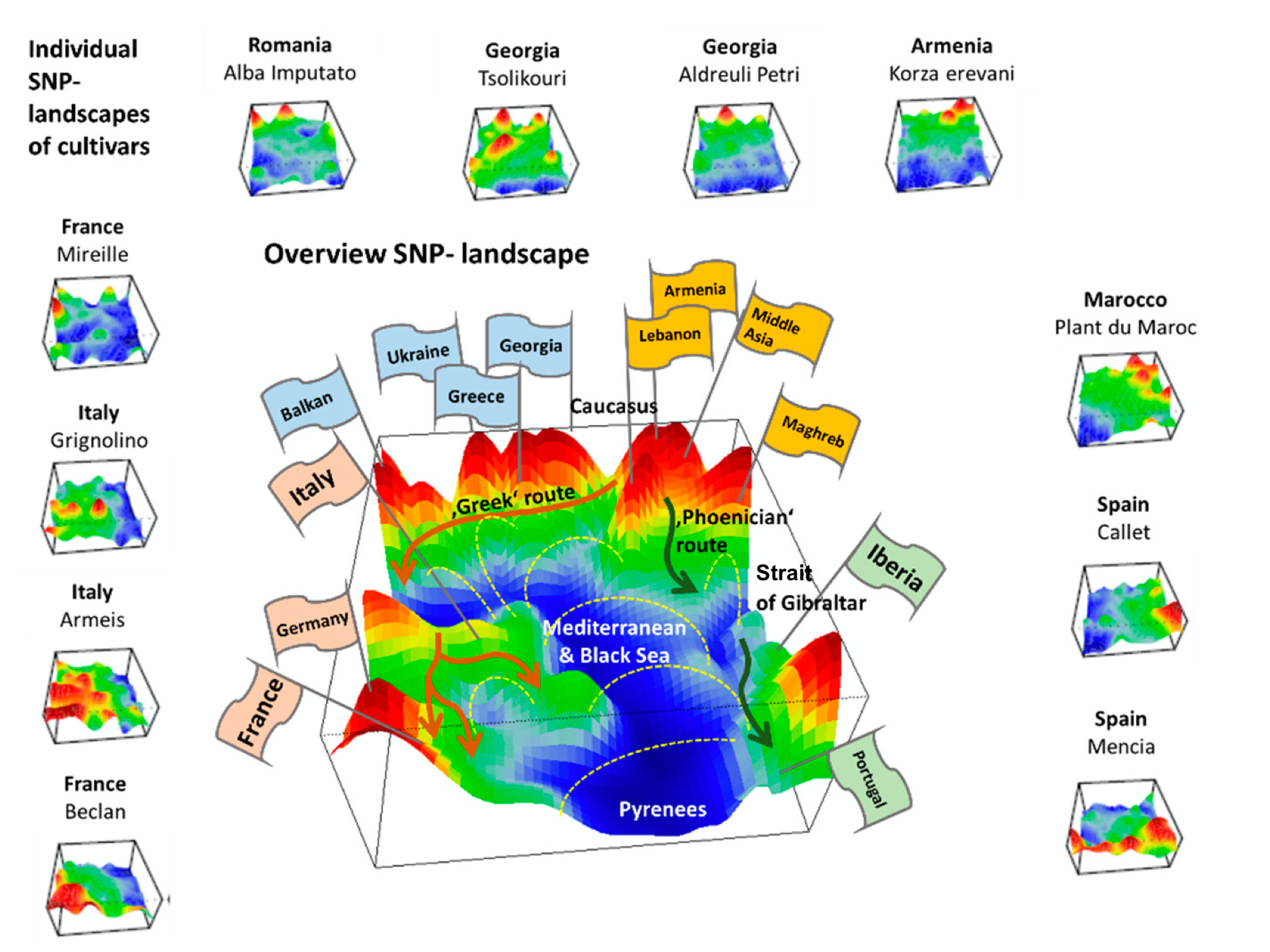 Figure. Genomic maps of grape cultivars: individual cultivar SNP-landscapes and an overview landscape annotated with geographic regions and the two proposed migration routes of cultivated grapes.
Based on the results, indicate whether the following statements are true or false.
Question reproduced from IBO 2022, Theoretical Paper 2, licensed under CC BY-NC-SA 4.0 - attributed to the International Biology Olympiad. Open the full exam PDF · Community solutions (unofficial)