Q97 - Telomerase-Dependent vs Alternative Telomere Lengthening in Testis
There are two mechanisms of telomere lengthening in a cell: the telomerase-dependent (TEL) pathway and the alternative telomere-lengthening (ALT) pathway. The activity of the TEL and ALT pathways has been studied in a number of healthy human tissues based on the expression of the genes involved in those pathways (see Figure). A pathway is considered active if the relative activity value is greater than 0.
Gene effect is measured by the Partial Influence (PI) metric. If PI is greater than 0, the gene activates the pathway; if less than 0, it suppresses the pathway; if 0, it does not affect the pathway activity. The greater the absolute value of PI, the greater the effect of that gene on pathway activation. Relative expression is the natural logarithm of the expression of a gene in a sample divided by the mean of the expression of that gene in all samples.
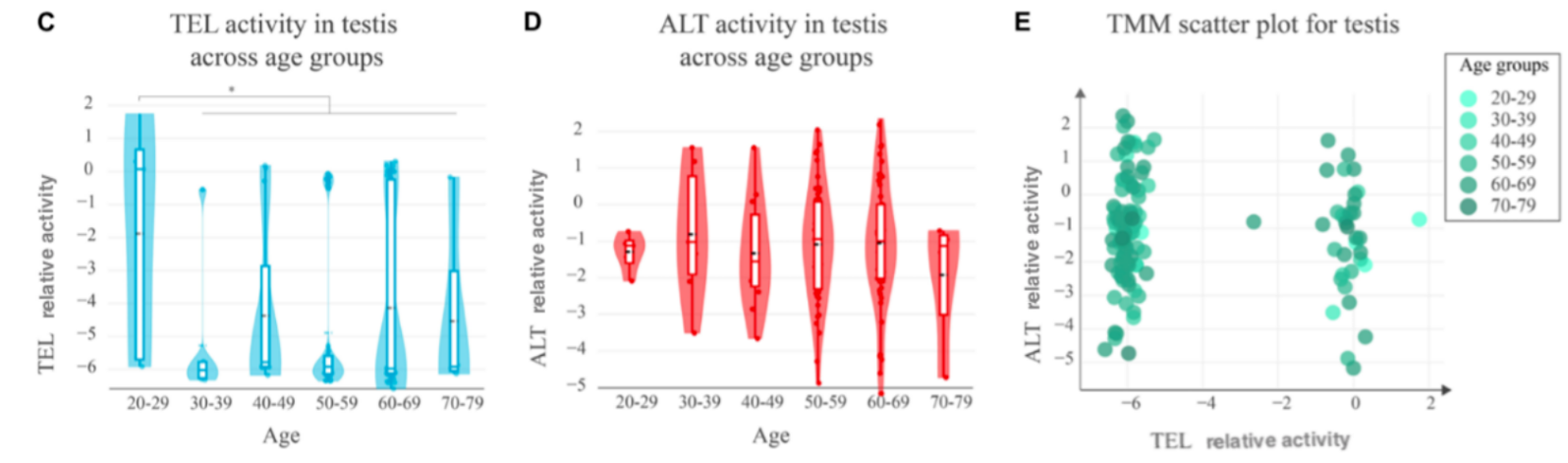 Figure (panels C–E). The relative activity values of the TEL and ALT pathways in testis across age groups (C–D), and a TMM scatter plot for testis (E).
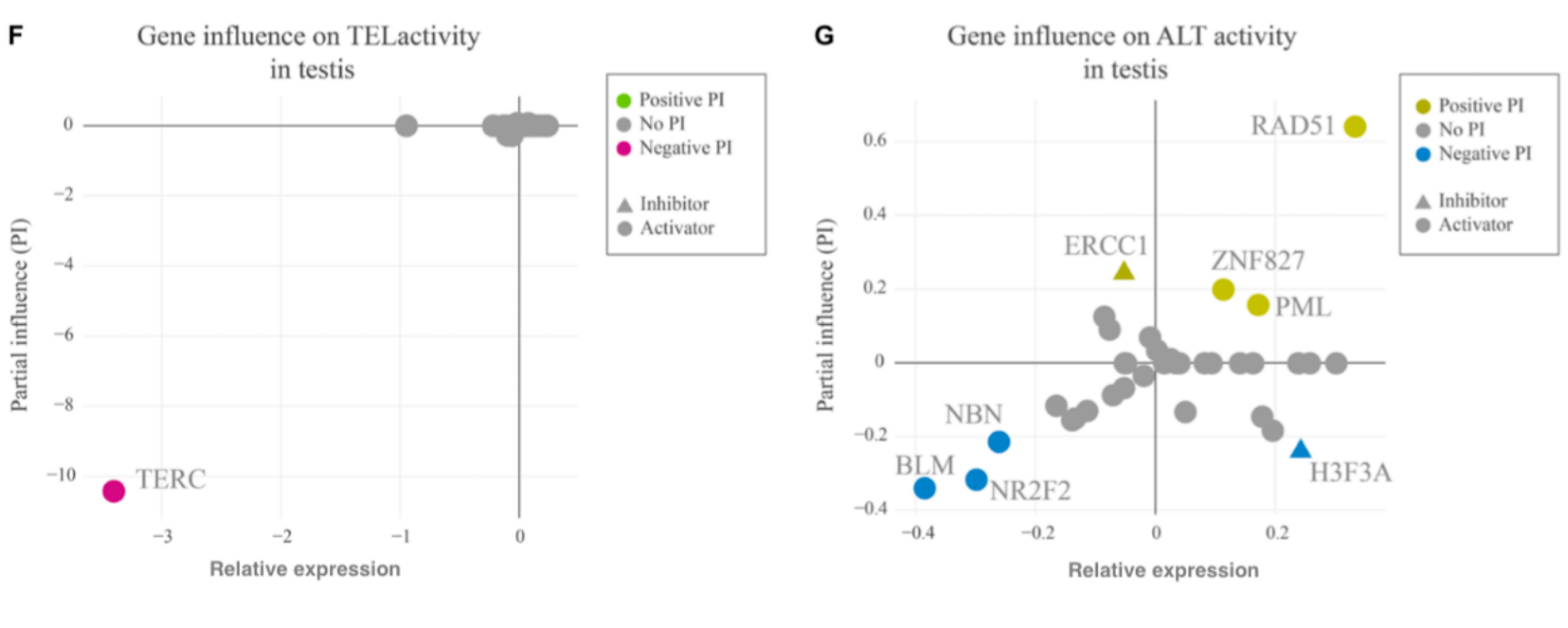 Figure (panels F–G). Gene influence on TEL and ALT pathway activity in testis, measured by Partial Influence (PI).
Using this information and analysis, determine whether the following statements are true or false.
Question reproduced from IBO 2022, Theoretical Paper 2, licensed under CC BY-NC-SA 4.0 - attributed to the International Biology Olympiad. Open the full exam PDF · Community solutions (unofficial)