Q1 - Skeletal Muscle Energy Sources
Skeletal muscle can be active over short or long times. There are several energy sources, each affecting the strength and endurance of muscles.
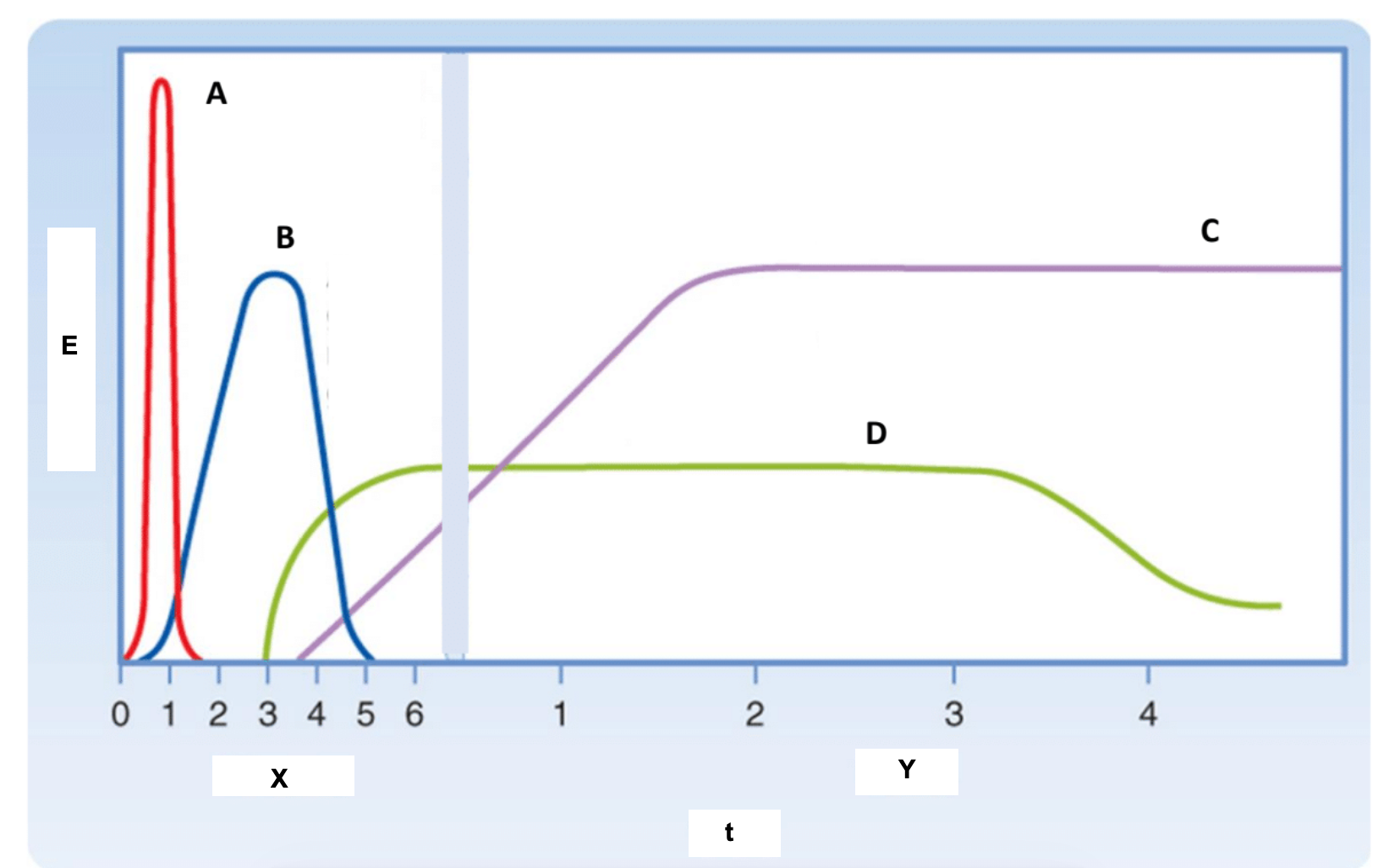 E = Energy, t = Time, X = Minutes, Y = Hours.
Match the corresponding curves (A-D), showing the contribution of each energy source to power generation, with the corresponding energy source (1-4):
- Aerobic oxidation: muscle glycogen, plasma glucose or liver glycogen
- Aerobic oxidation: adipose tissue triglycerides and plasma fatty acids
- ATP + creatine phosphate
- Anaerobic oxidation: muscle glycogen
Q1.1. Aerobic oxidation: muscle glycogen, plasma glucose or liver glycogen corresponds to which curve?
Q1.2. Aerobic oxidation: adipose tissue triglycerides and plasma fatty acids corresponds to which curve?
Q1.3. ATP + creatine phosphate corresponds to which curve?
Q1.4. Anaerobic oxidation: muscle glycogen corresponds to which curve?
Question reproduced from IBO 2023, Theoretical Paper 1, licensed under CC BY-NC-SA 4.0 - attributed to the International Biology Olympiad. Open the full exam PDF