Q2 - Smooth Muscle Contraction Dynamics
The smooth muscle in various organs behaves differently, and has specialised contraction/relaxation dynamics.
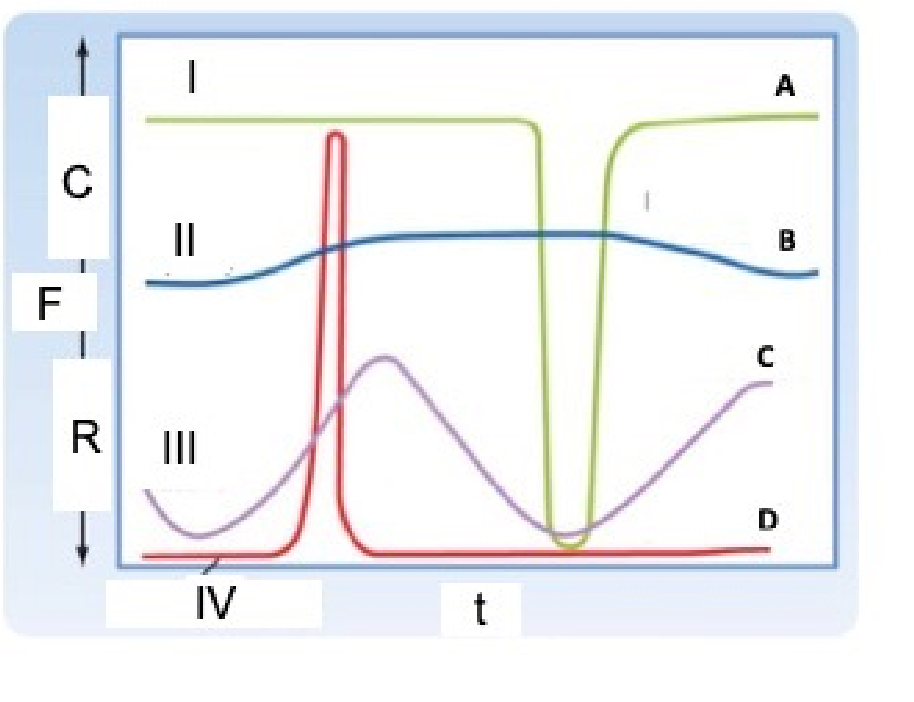 C = Contraction/Force, R = Relaxation, t = Time. I = Normally contracted, II = Normally partially contracted (tone), III = Phasically active, IV = Normally relaxed.
Match the four curves (A-D) with the four corresponding organs (1-4):
- Sphincters
- Oesophagus, urinary bladder
- Blood vessels, airways
- Stomach, intestines
Q2.1. Sphincters correspond to which curve?
Q2.2. Oesophagus and urinary bladder correspond to which curve?
Q2.3. Blood vessels and airways correspond to which curve?
Q2.4. Stomach and intestines correspond to which curve?
Question reproduced from IBO 2023, Theoretical Paper 1, licensed under CC BY-NC-SA 4.0 - attributed to the International Biology Olympiad. Open the full exam PDF