Q22 - Mendel's Round and Wrinkled Peas: PCR Analysis
Gregor Mendel described the inheritance of round and wrinkled pea seeds. He showed the round (R) phenotype was dominant over wrinkled (r).
After 135 years, the gene SBE1, and the insertion of a transposable element which caused the wrinkled phenotype, were discovered. SBE1 codes for an enzyme involved in starch biosynthesis. Wrinkled seeds are characterized by higher levels of sucrose, and lower levels of starch, compared to round seeds.
In a PCR test, a pair of primers, targeting flanking sides of the site of insertion, are used to amplify the genomic DNA. The products are resolved by agarose gel electrophoresis.
A geneticist made two independent crosses (I and II) between peas with different genotypes. 30 progeny from each cross was analyzed by PCR. Each lane in the gel below represents analysis of one progeny.
The downward arrow denotes the direction of migration.
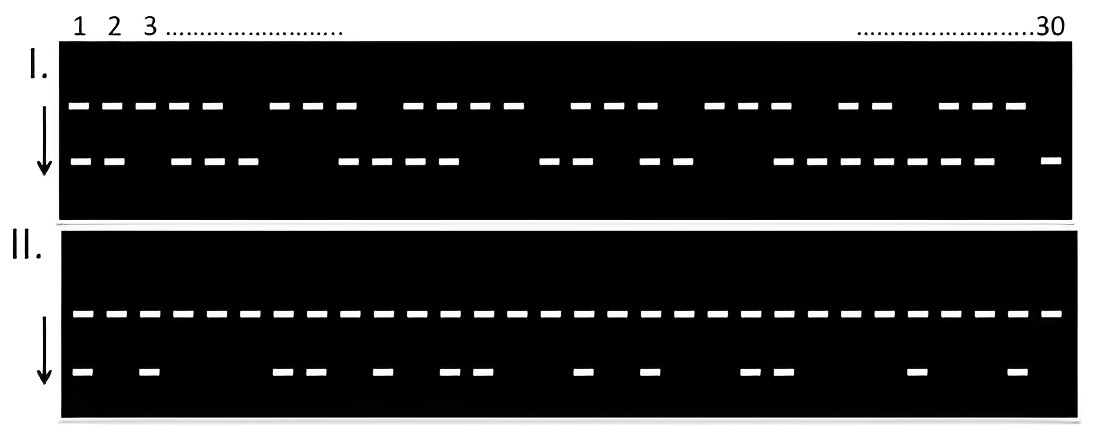 PCR gel results. Cross I (top): three progeny types visible. Cross II (bottom): two progeny types visible. The larger (upper) band corresponds to the allele with the transposon insertion (r), and the smaller (lower) band corresponds to the wild-type allele (R).
Question reproduced from IBO 2023, Theoretical Paper 1, licensed under CC BY-NC-SA 4.0 - attributed to the International Biology Olympiad. Open the full exam PDF