Q23 - Genomic Imprinting Pedigree
The pedigree shows the inheritance pattern of gene X, whose mutation leads to a disorder in adults.
- The mutation leads to a loss-of-function allele.
- In addition, gene X undergoes genomic imprinting.
- In this case, the imprint prevents the allele from being expressed.
The expression of alleles that are subject to imprinting depends on whether they were inherited from the mother or the father. When the imprinting takes place during sperm formation, it is called paternal imprinting. If it takes place during formation of the egg, it is known as maternal imprinting. In each generation, the imprints are reset during gametogenesis.
Individuals who are carriers for the mutant allele are marked with a dot. Individuals showing the disorder are shaded. Individuals in generation IV have not reached adulthood and the presence of the mutant allele has not been analyzed.
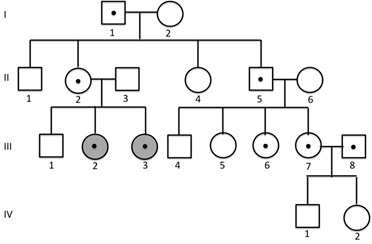 Pedigree of gene X. Dots indicate carriers of the mutant allele. Shaded individuals show the disorder.
Question reproduced from IBO 2023, Theoretical Paper 1, licensed under CC BY-NC-SA 4.0 - attributed to the International Biology Olympiad. Open the full exam PDF