Q10 - Cardiac Cell 14C Dating
The contribution of cell propagation to physiological heart growth and maintenance in humans has been difficult to study.
70–60 years ago, atomic bomb testing introduced a large amount of 14C into the biosphere, followed by a rapid drop back to background amounts when the UK, USA and USSR agreed to end testing. The ratio between 12C and 14C isotopes can be quantified in the fractions of individual cardiac cells (mesenchymal cells, endothelial cells and cardiomyocytes). Dating the correct biomolecule allows individual cells to be aged (14C dating).
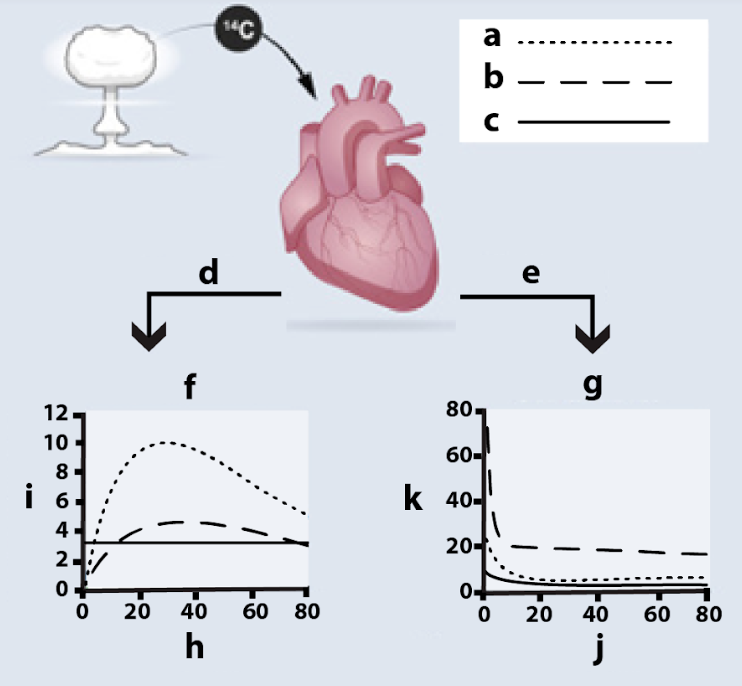
True or False?
Q10.1. Myosin is the molecule within a cell most likely to maintain the original ratio of the C12 and C14 from when the cell was formed.
Q10.2. These data show cardiomyocytes are able to increase their volume over time.
Q10.3. These data show adults possess only small amounts, if any, cardiomyocyte stem cells.
Q10.4. The half-life of 14C must be taken into account when interpreting the results.
Question reproduced from IBO 2023, Theoretical Paper 2, licensed under CC BY-NC-SA 4.0 - attributed to the International Biology Olympiad. Open the full exam PDF