Q19 - cAMP Signaling and Caffeine
Some of the numerous physiological effects of caffeine consumption are based on the similarity of its structure to adenosine.
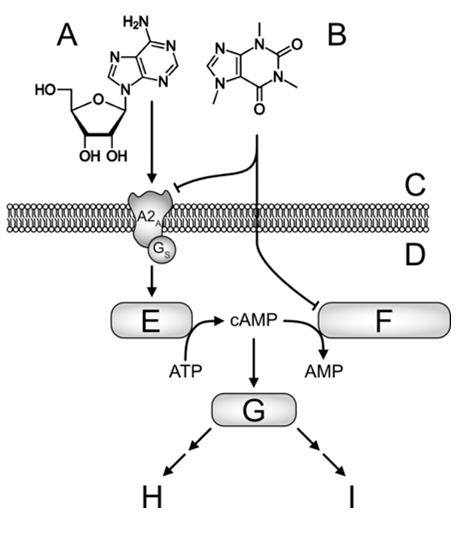
- Adenosine interacts with the A2A receptor, which activates adenylyl cyclase via the GS protein, resulting in the synthesis of cyclic AMP (cAMP), a signalling molecule in the cell.
- cAMP molecules directly interact with protein kinase A and cause the activation of this enzyme. Protein kinase A phosphorylates substrate proteins and produces certain physiological effects.
- cAMP molecules are broken down by phosphodiesterase to AMP, therefore the signal caused by the interaction of adenosine with the A2A receptor disappears after some time.
Caffeine can also interact with the A2A receptor, but it does not cause the exact same effects as adenosine. In addition, caffeine is a phosphodiesterase inhibitor.
True or False?
Q19.1. Enzymatic synthesis of cAMP molecules amplifies the signal.
Q19.2. Caffeine inhibits the increase in cAMP concentration usually caused by the activated A2A receptor.
Q19.3. Caffeine slows down the decline in cAMP level after receptor activation.
Q19.4. Caffeine is likely to be a competitor of adenosine at the receptor.
Question reproduced from IBO 2023, Theoretical Paper 2, licensed under CC BY-NC-SA 4.0 - attributed to the International Biology Olympiad. Open the full exam PDF