Q21 - Aconitase Mechanism
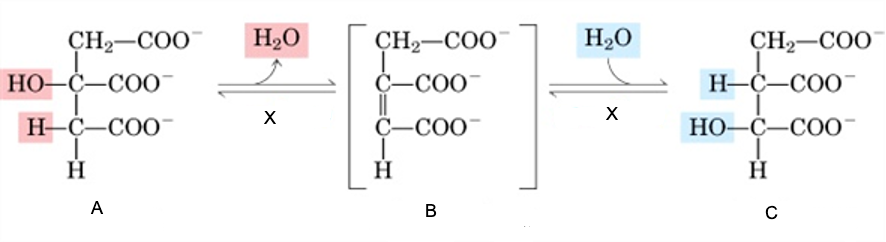
Aconitase, one of the enzymes in the TCA cycle (Krebs cycle / citric acid cycle), catalyzes the following reaction:
Citrate ⇌ cis-Aconitate ⇌ Isocitrate
In order to explore its mechanism, reactions were carried out in D2O, instead of H2O. D represents deuterium (heavy hydrogen).
A reverse enzymatic reaction using isocitrate as the substrate did NOT produce any labeled citrate. When starting from cis-aconitate, all produced citrate had a D atom. Do not consider hydroxyl transfer with the environment in this reaction.
True or False?
Q21.1. The reaction mechanism involves proton (H+) transfer.
Q21.2. Cis-aconitate remains bound, in the same orientation, to the enzyme active site throughout the whole reaction.
Q21.3. The labeled H atoms in the figure are the same individual atoms in citrate and isocitrate.
Q21.4. The enzyme has only one catalytic base (e.g. serine) in its active site.
Q21.5. The enzyme needs a coenzyme as redox center e.g. FAD.
Question reproduced from IBO 2023, Theoretical Paper 2, licensed under CC BY-NC-SA 4.0 - attributed to the International Biology Olympiad. Open the full exam PDF