Q3 - Shell Drilling Predation
A fictional marine bivalve mollusk ‘sea carpet bag’ is a prey of carnivorous sea snails. The sea snails drill through bivalve shells to inject poison which relaxes the bivalve muscle-adductor. Muscle-adductor relaxation allows bivalve shells to be opened and the hunting snail eats the sea carpet bag.
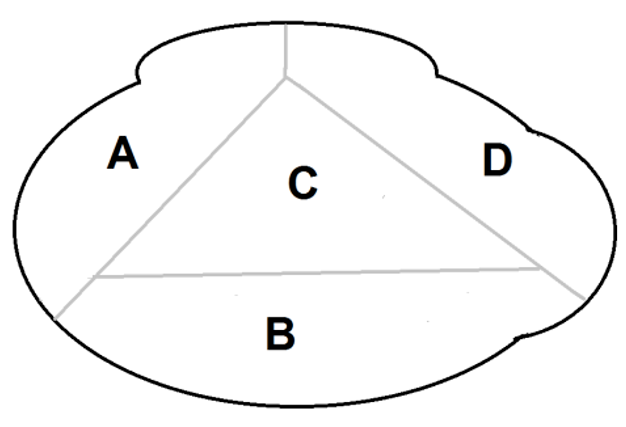
Scientists divided the surface of sea carpet bag shells into four areas with equal size:
- A - anterior area
- B - basal area
- C - central area
- D - distal area
A representative set of 100 dead sea carpet bags was analyzed. The number of holes drilled by hunting snails in different areas, and their combinations, are shown in the Table.
| Drilling Position | Number of shells |
|---|---|
| Single hole | |
| A | 23 |
| B | 5 |
| C | 6 |
| D | 25 |
| Pairwise combination | |
| AB | 4 |
| AC | 4 |
| AD | 16 |
| BC | 1 |
| BD | 3 |
| CD | 5 |
| Triple combination | 2 (1 ABD and 1 ACD) |
| No holes | 6 |
True or False?
Question reproduced from IBO 2023, Theoretical Paper 2, licensed under CC BY-NC-SA 4.0 - attributed to the International Biology Olympiad. Open the full exam PDF