Q1 - Tulip Parsimony and Morphological Characters
Kazakhstan boasts a rich ecosystem harboring numerous species of tulips, some of which are direct ancestors to many modern cultivated varieties. These tulips exhibit a diverse range of morphological traits, although not all of these traits are reliable indicators of species identification.
In Table 1 below, we outline five distinct types of tulips and their variations across five characteristics (A-E), typically utilized in the classification of tulip types.
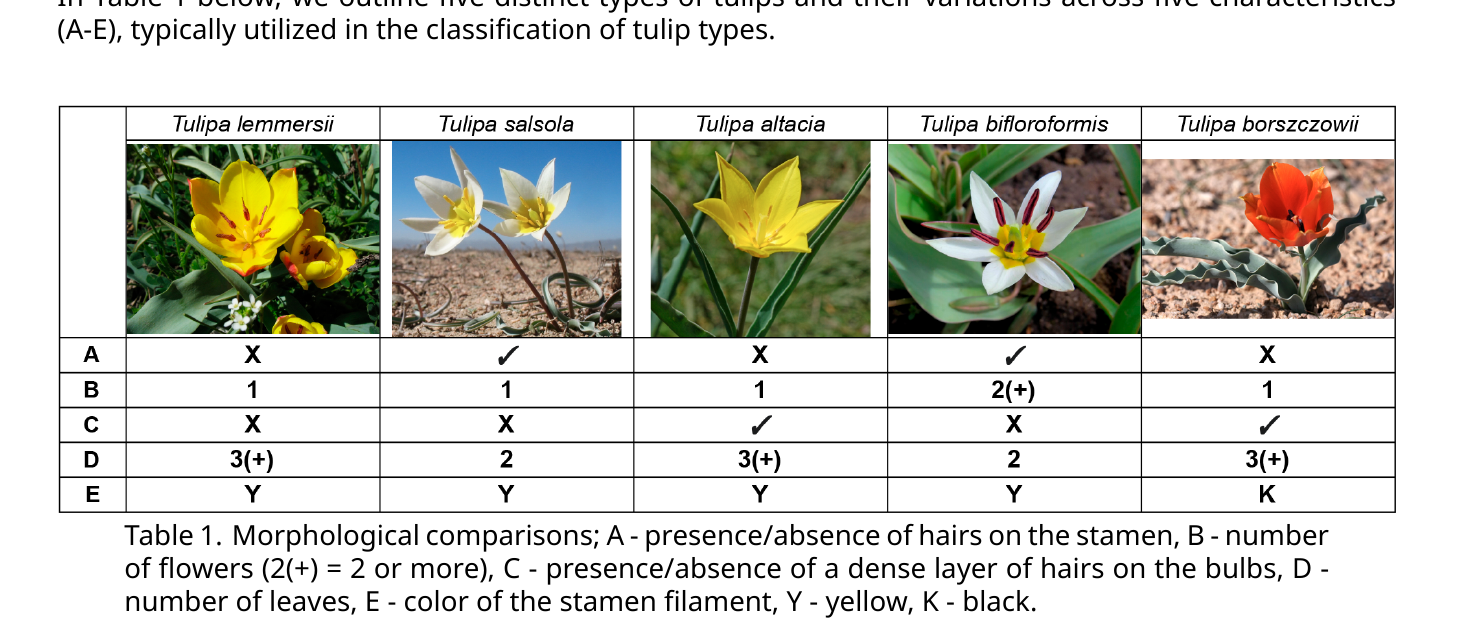 Table 1. Morphological comparisons; A - presence/absence of hairs on the stamen, B - number of flowers (2(+) = 2 or more), C - presence/absence of a dense layer of hairs on the bulbs, D - number of leaves, E - color of the stamen filament, Y - yellow, K - black.
It’s worth noting that T. borszczowii has the same features as the common ancestor among these tulip species.
On your answer sheet, indicate “T” for true statements and “F” for false ones.
Question reproduced from IBO 2024, Theoretical Exam Part A, licensed under CC BY-NC-SA 4.0 - attributed to the International Biology Olympiad. Open the full exam PDF · Community solutions (unofficial)