Q13 - Nitrogen Limitation of Legumes in Steppes
Legumes can fix nitrogen from the air. Anecdotal evidence showed industrial pollution with nitrogen and other macronutrients making legumes less fit for nitrogen-poor steppes and other grasslands, which make up half of Kazakhstan.
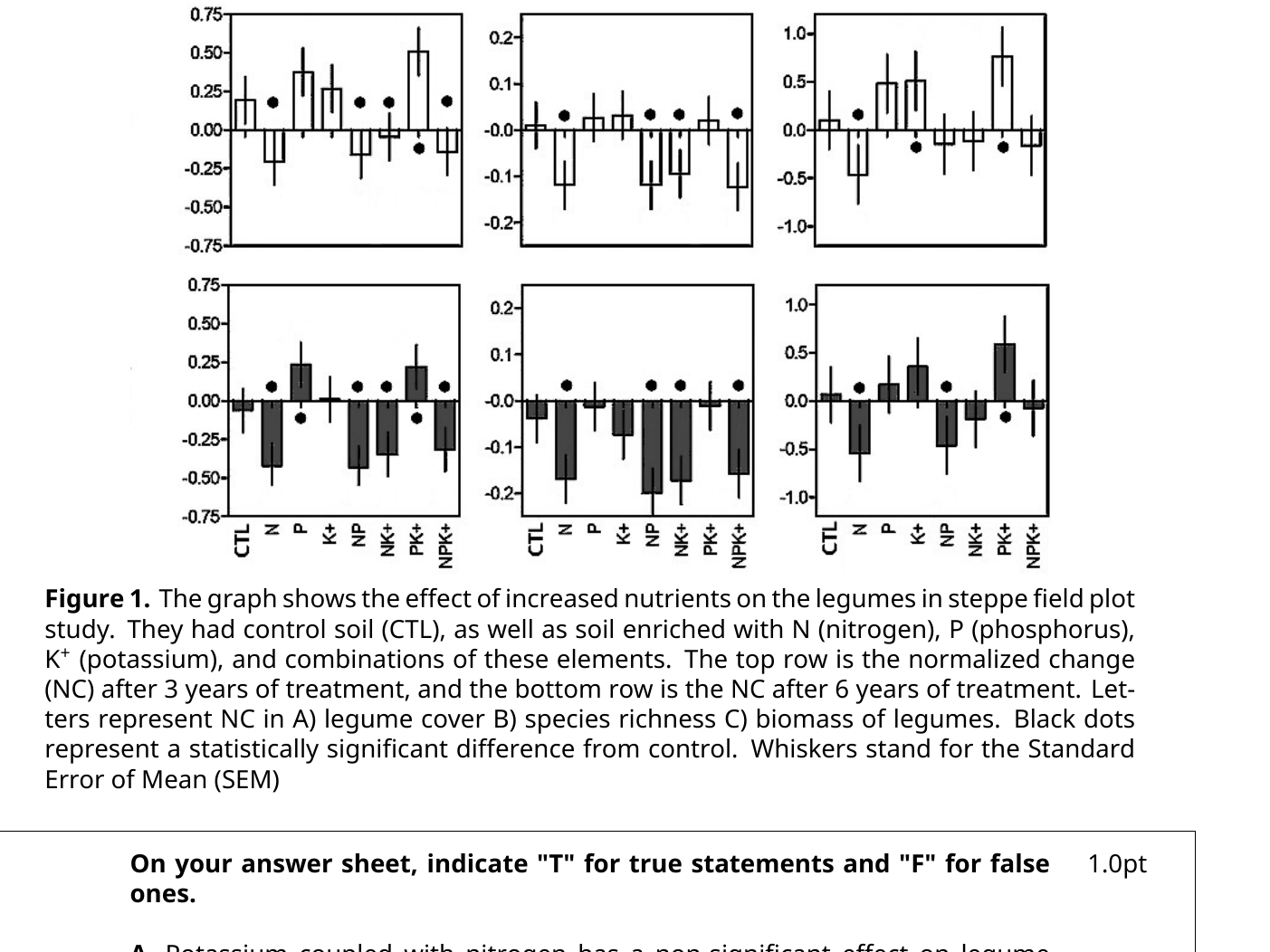 Figure 1. The graph shows the effect of increased nutrients on the legumes in steppe field plot study. They had control soil (CTL), as well as soil enriched with N (nitrogen), P (phosphorus), K⁺ (potassium), and combinations of these elements. The top row is the normalized change (NC) after 3 years of treatment, and the bottom row is the NC after 6 years of treatment. Letters represent NC in A) legume cover B) species richness C) biomass of legumes. Black dots represent a statistically significant difference from control. Whiskers stand for the Standard Error of Mean (SEM).
On your answer sheet, indicate “T” for true statements and “F” for false ones.
Question reproduced from IBO 2024, Theoretical Exam Part A, licensed under CC BY-NC-SA 4.0 - attributed to the International Biology Olympiad. Open the full exam PDF · Community solutions (unofficial)