Q18 - Animal Road Barrier Effect (Traffic Behavior Types)
Roads are responsible for habitat fragmentation, impeding wildlife movement via the “Barrier effect,” which combines direct mortality from collisions with animal avoidance behaviour. Note that animal response to moving cars can resemble their reaction to natural danger stimuli. The research identified four types of animal behavioural responses (see Table 1) based on their perceived danger from traffic. Each animal species typically exhibits only one of these behavioral responses.
| Behavior type | Description |
|---|---|
| Speeders | Their primary response to threats is to flee across the road. |
| Avoiders | Avoid the road at much lower traffic volume and remain further from the road than other types. |
| Nonresponders | Do not cease their movement at any level of traffic intensity. |
| Pausers | Reduce their speed by freezing, which increases the time spent on the roadway. |
Table 1. Types of animal behavioural responses to traffic. Traffic volume entails the number of vehicles passing a point on a road segment.
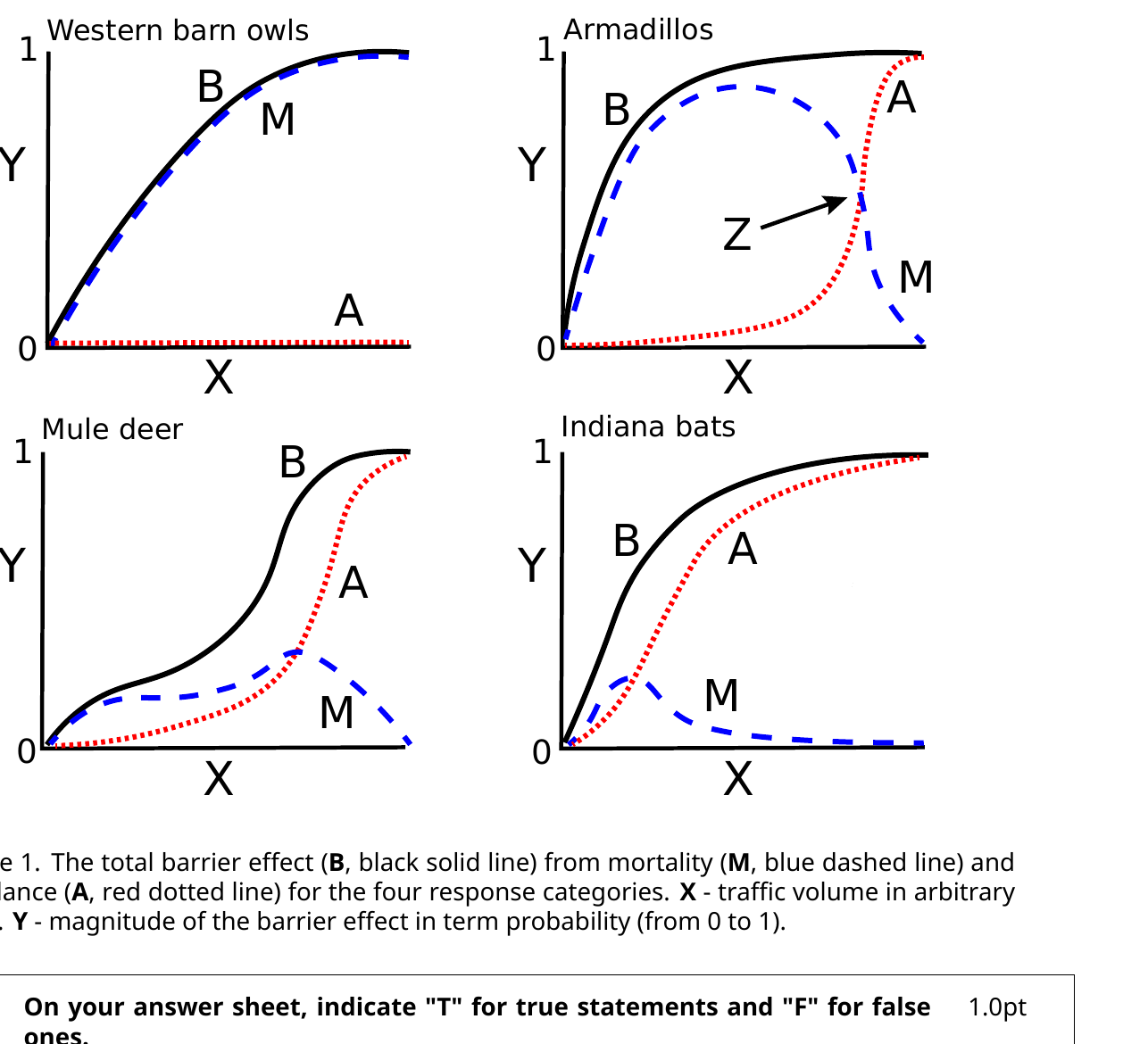 Figure 1. The total barrier effect (B, black solid line) from mortality (M, blue dashed line) and avoidance (A, red dotted line) for the four response categories. X - traffic volume in arbitrary units. Y - magnitude of the barrier effect in term probability (from 0 to 1).
On your answer sheet, indicate “T” for true statements and “F” for false ones.
Question reproduced from IBO 2024, Theoretical Exam Part A, licensed under CC BY-NC-SA 4.0 - attributed to the International Biology Olympiad. Open the full exam PDF · Community solutions (unofficial)