Q19 - Cumulative Cultural Evolution in Rock Pigeons
Individual progress and subsequent social learning are important aspects of group living. The progressive accumulation of culture within a group over time is called Cumulative Cultural Evolution (CCE). The following study aimed to investigate the interplay between CCE and collective decision-making. Rock pigeons (Columba livia) building routes between two distant points were taken as a model system.
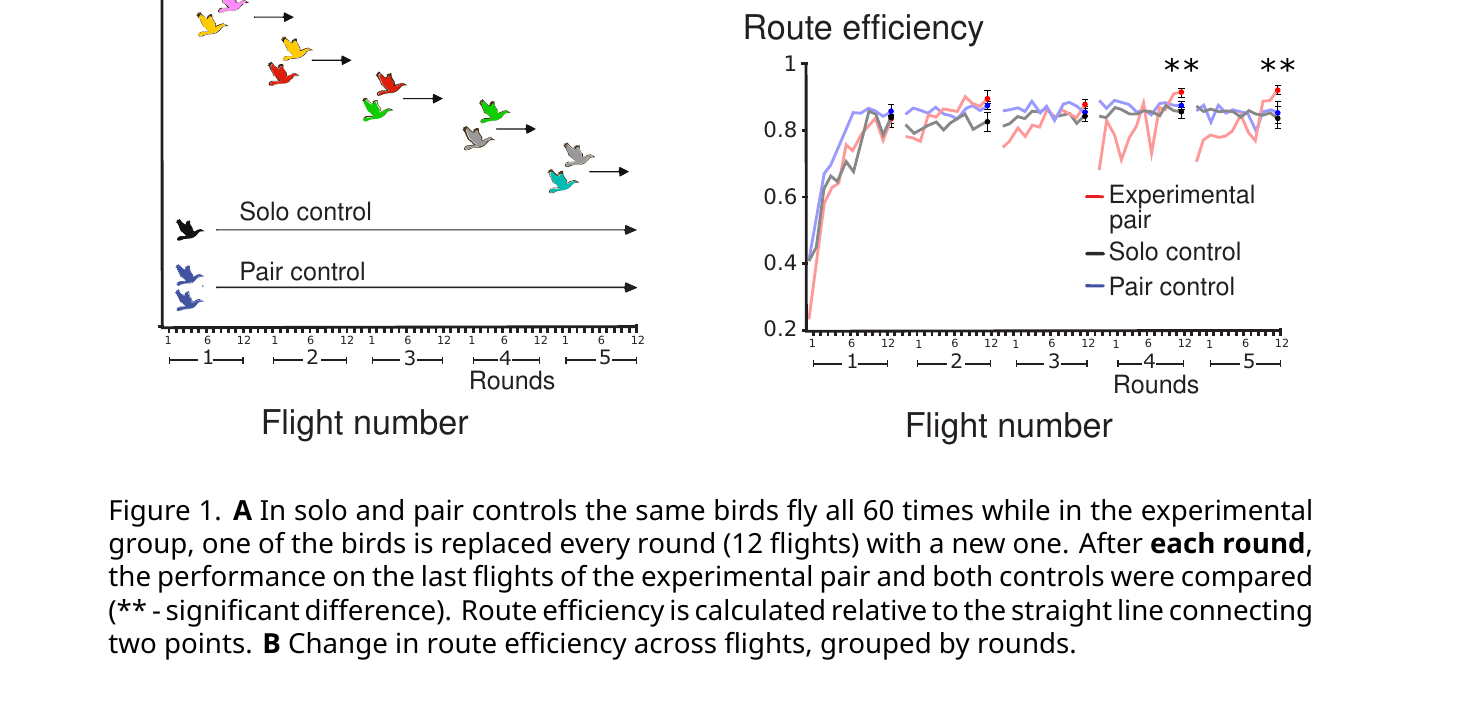 Figure 1. A In solo and pair controls the same birds fly all 60 times while in the experimental group, one of the birds is replaced every round (12 flights) with a new one. After each round, the performance on the last flights of the experimental pair and both controls were compared (asterisks mark a significant difference). Route efficiency is calculated relative to the straight line connecting two points. B Change in route efficiency across flights, grouped by rounds.
On your answer sheet, indicate “T” for true statements and “F” for false ones.
Question reproduced from IBO 2024, Theoretical Exam Part A, licensed under CC BY-NC-SA 4.0 - attributed to the International Biology Olympiad. Open the full exam PDF · Community solutions (unofficial)