Q34 - Maize Leaf Carbohydrate Allocation
After producing C3 sugars in the Calvin Cycle, plant cells can further produce other carbohydrates for structural growth, starch, and soluble carbohydrates. Discounting their structural use, the allocation of sugars between starch and soluble carbohydrates within the leaf can be used to assess the yield potential of crop plants.
Researchers looked into the change in the ratio of starch to soluble sugars between different growing stages across three different breeds of maize (Zea mays). They looked into the leaf carbohydrates during two vegetative and one reproductive stages. During the latter, the fast-growing kernels require large amounts of carbohydrates, making them suitable for future human consumption.
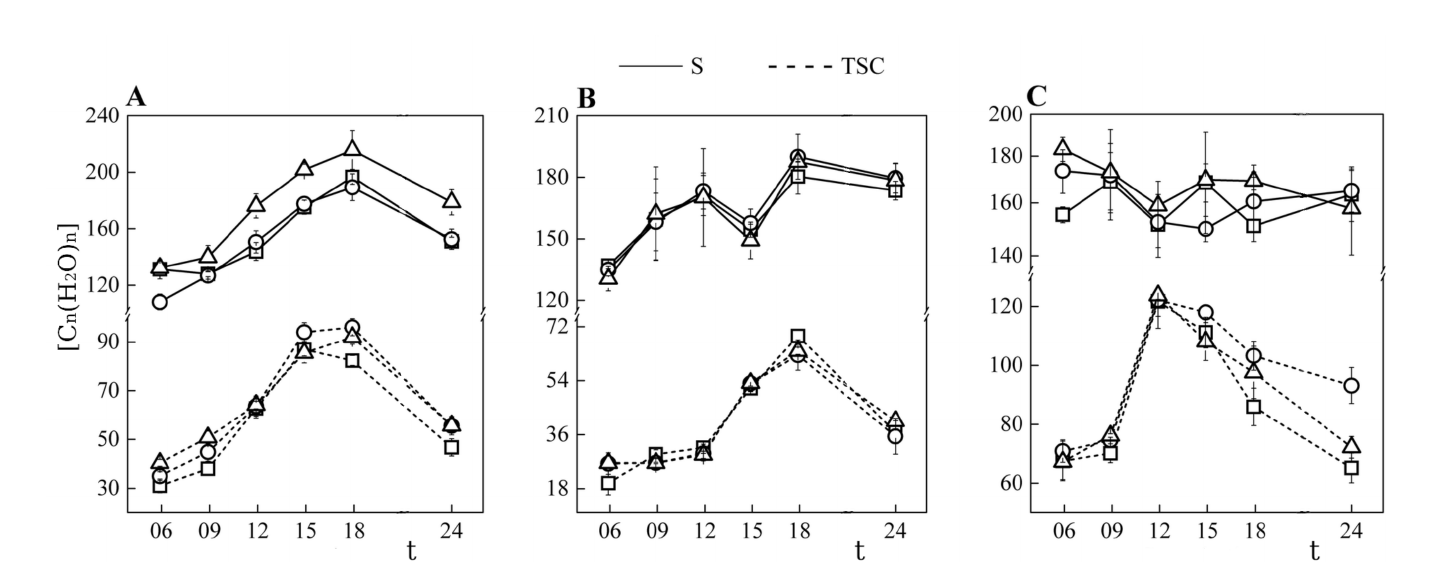 Figure 1. S – starch concentration in leaves, TSC – total soluble carbohydrate concentration in leaves. t – hour of the day. A, B, and C are plots for two vegetative stages and the reproductive stage respectively. Different shapes represent the three cultivars.
On your answer sheet, indicate “T” for true statements and “F” for false ones.
Question reproduced from IBO 2024, Theoretical Exam Part A, licensed under CC BY-NC-SA 4.0 - attributed to the International Biology Olympiad. Open the full exam PDF · Community solutions (unofficial)