Q33 - Xanthophyll Cycle and Photoprotection
Xanthophylls are yellow-orange colored and fat-soluble photoprotective pigments. This is likely an adaptation to the unforgiving sunlight in dry ecosystems. As excess light leads to the accumulation of protons in the thylakoid’s lumen, this lower pH triggers a transformation of precursors (Pre-Z) into zeaxanthin (Z). All of them are xanthophylls.
When protonated, Z changes the conformation of photosystem II to dissipate extra light energy as heat. Reduced ascorbate is a cofactor for de-epoxidase, the enzyme that catalyzes the Pre-Z → Z reactions.
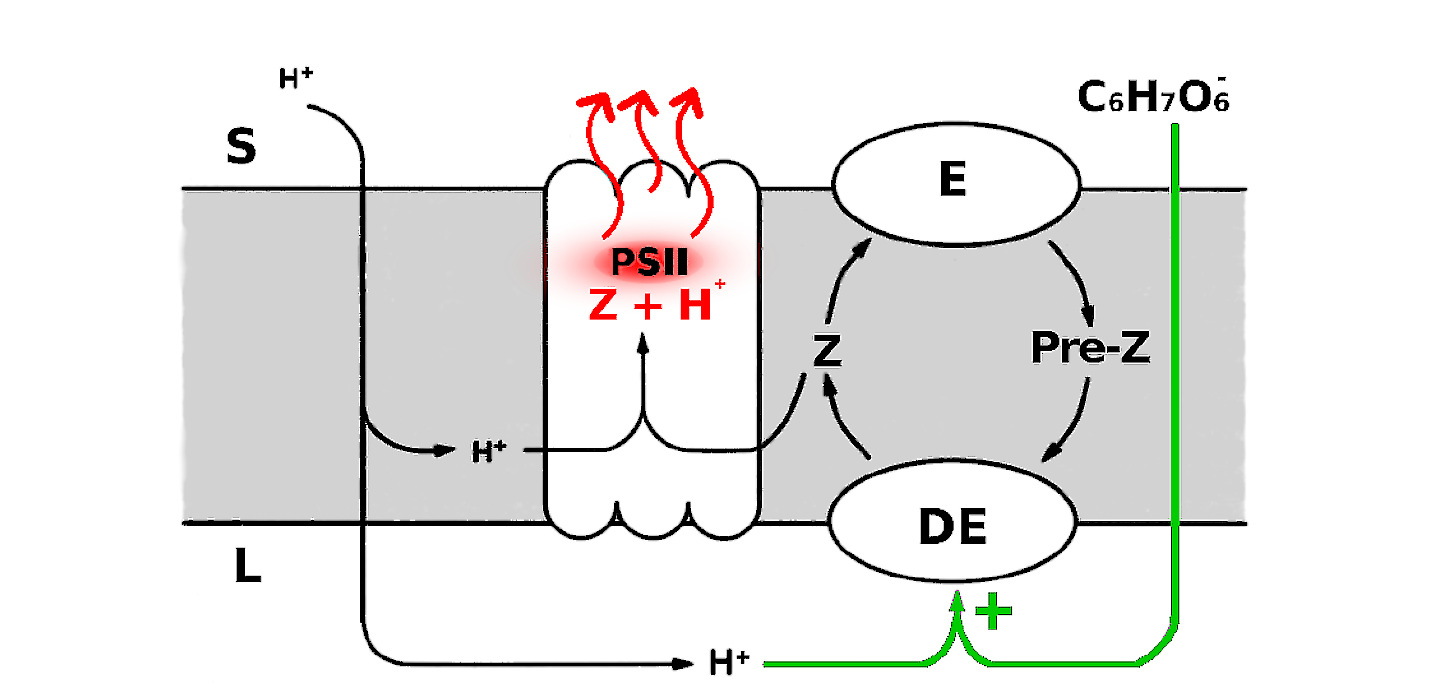 Figure 1. A diagram of the thylakoid membrane, where S – stroma, L – lumen, E – epoxidase, DE – de-epoxidase, PSII – photosystem II, C6H7O6- – ascorbate, red wavy arrows – heat, and green arrows with the plus sign – activation.
On your answer sheet, indicate “T” for true statements and “F” for false ones.
Question reproduced from IBO 2024, Theoretical Exam Part A, licensed under CC BY-NC-SA 4.0 - attributed to the International Biology Olympiad. Open the full exam PDF · Community solutions (unofficial)