Q41 - Octopus Active Sleep and Circadian Control
In Octopus laqueus, two distinct sleep stages are observed: active (AS) and quiet (QS). Active sleep is marked by active bouts, which include only specific body and eye movements along with transitions in skin patterns, occurring between periods of quiet sleep. There are potential parallels between vertebrates’ non-REM and REM (Rapid Eye Movement) sleep phases and octopuses’ QS and AS stages, respectively. Researchers measured the occurrence of active bouts in the group of octopuses during the day and night and in the interrupted conditions as seen in Figure 1.
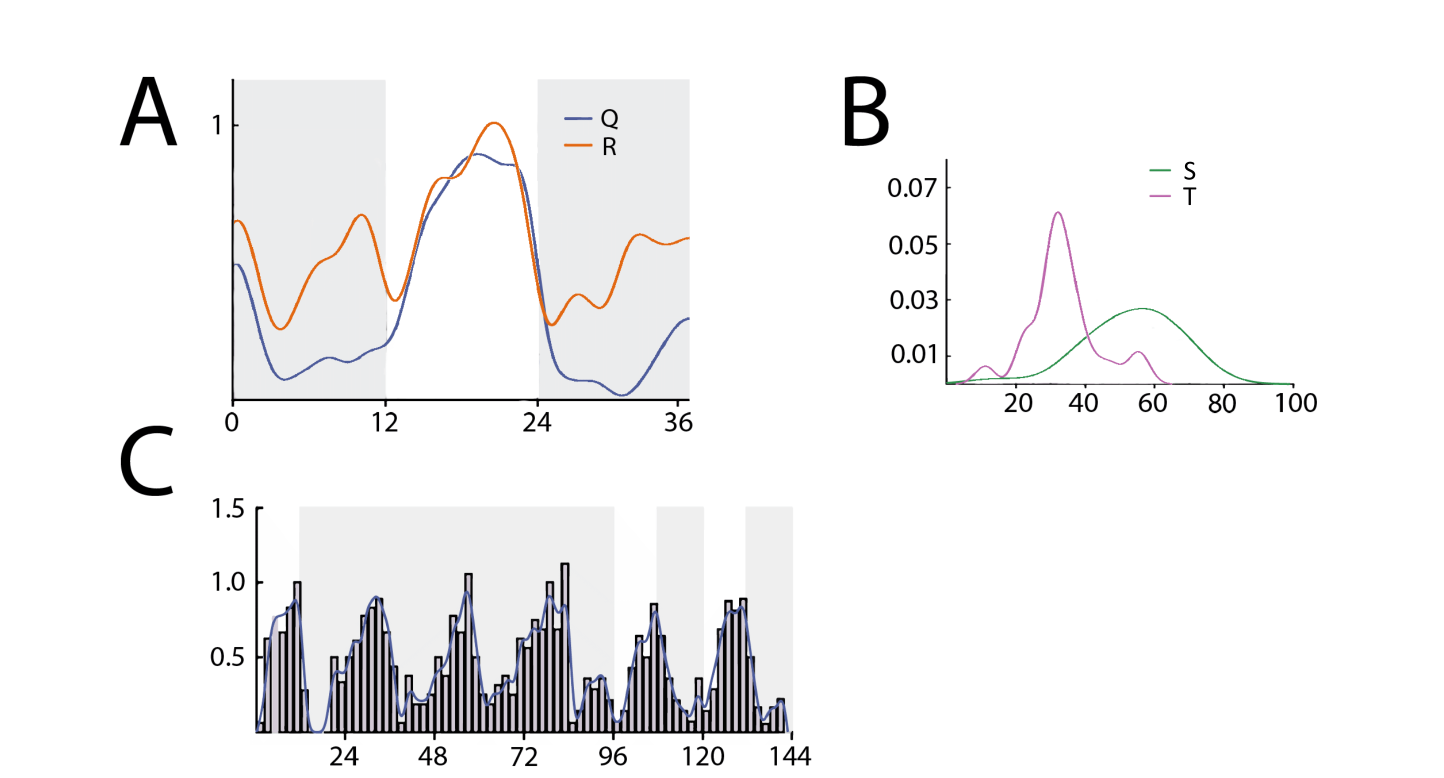 Figure 1. A Average number of active bouts per hour over 36 hours before (Q) and after (R) 2-day sleep deprivation (darkness is depicted in gray background areas). B Probability of the next bout (Y-axis) occurring N minutes after (X-axis) a normal (S) or interrupted (T) bout. C Active bouts per hour (Y-axis) during 3 days of constant darkness (darkness is depicted in gray background areas).
On your answer sheet, indicate “T” for true statements and “F” for false ones.
Question reproduced from IBO 2024, Theoretical Exam Part A, licensed under CC BY-NC-SA 4.0 - attributed to the International Biology Olympiad. Open the full exam PDF · Community solutions (unofficial)