Q46 - Channelrhodopsin-2 (ChR2) in Hippocampal Neurons
The discovery of light-gated cation channels quickly led to the development of new tools and applications, notably the optical control of neural activity using algal channelrhodopsin-2 (ChR2).
Viral vectors were used to express ChR2 in rat hippocampal neurons, and ChR2 membrane localization was observed. A series of experiments was conducted to investigate the properties of these transduced cells, and the resulting data are presented below.
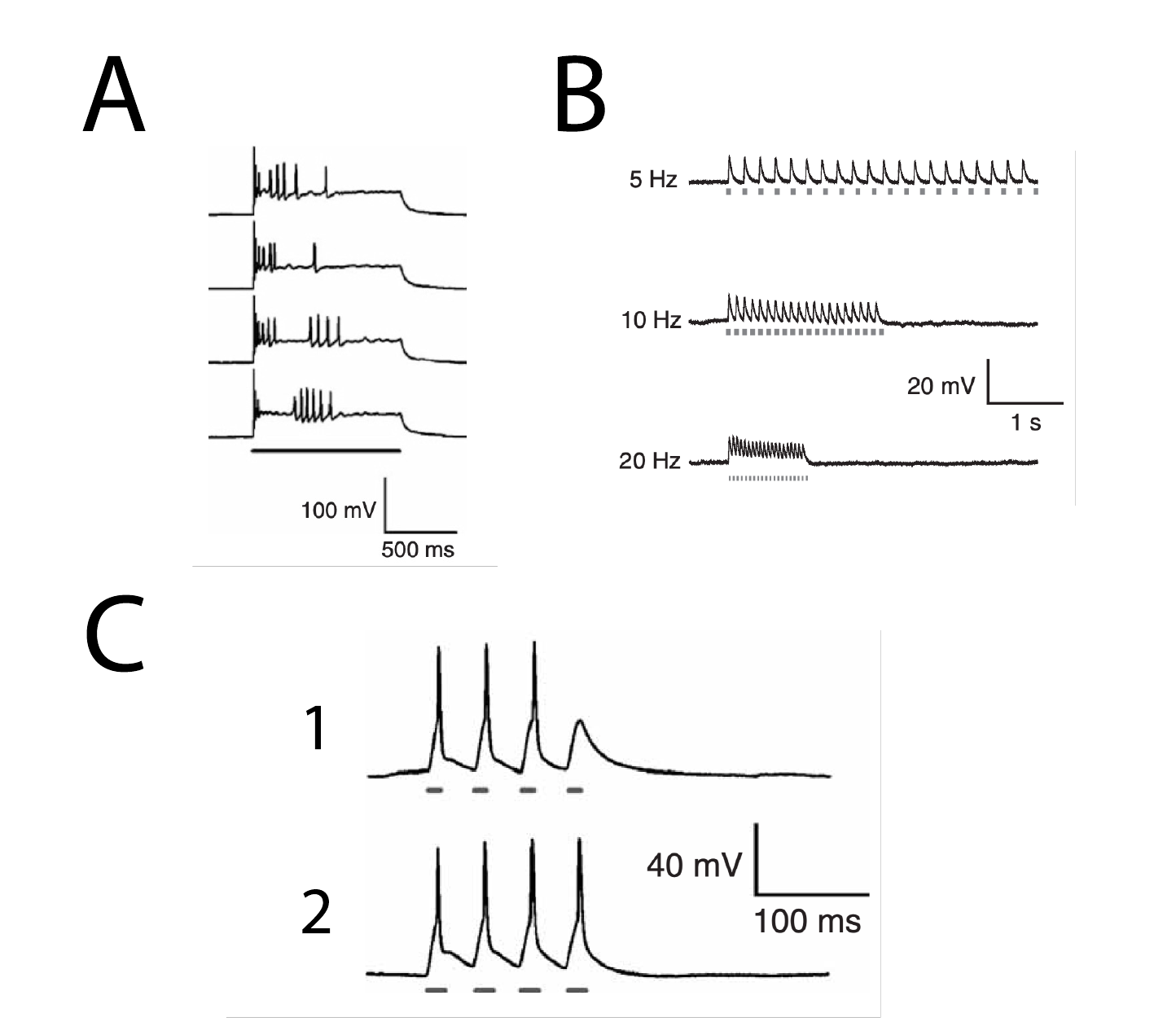 Figure 1. A Voltage traces and spikes in a hippocampal neuron evoked by 1-second periods of light (4 repeated experiments). B Voltage traces showing subthreshold depolarizations in response to light pulses. C Voltage traces in response to brief light pulse series. Bars below the records indicate light pulses.
On your answer sheet, indicate “T” for true statements and “F” for false ones.
Question reproduced from IBO 2024, Theoretical Exam Part A, licensed under CC BY-NC-SA 4.0 - attributed to the International Biology Olympiad. Open the full exam PDF · Community solutions (unofficial)