Q14 - Aral Sea Food-Chain Restoration and Salinity Tolerance
The Aral Sea, located in the southwest of Kazakhstan, was one of the largest salt lakes in the world before drying out. Today, the Aral Sea has two basins: Northern and Southern. Freshwater rivers: Syr Darya flows into the Northern basin and Amu Darya flows into the Southern basin. The water from Amu Darya is overused in agriculture, thus only a small part flows into the sea.
One way of restoring the biota of the Aral Sea is by introducing a food chain of new organisms into the sea. Note that species W and Z are native to the Aral Sea ecosystem, and also inhabit freshwater rivers flowing into the Aral Sea.
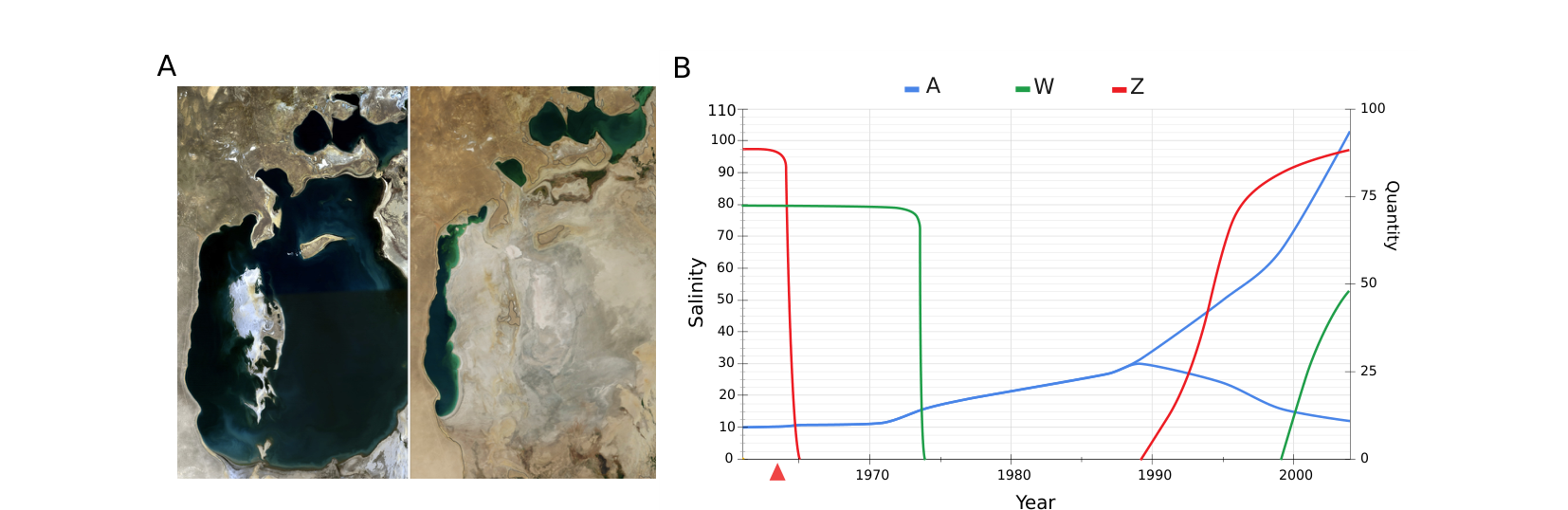 Figure 1. A The Aral Sea before and after. B Graph of changes in the salinity of both basins (mg/mL) and quantity metric of adult organisms (arbitrary units). A – salinity, W – species W, Z – species Z. The red arrow indicates the artificial introduction of a community of new species.
On your answer sheet, indicate “T” for true statements and “F” for false ones.
Question reproduced from IBO 2024, Theoretical Exam Part B, licensed under CC BY-NC-SA 4.0 - attributed to the International Biology Olympiad. Open the full exam PDF