Q20 - Female Body Mass, Male Fighting, and Mating Outcomes in Crickets
Mating and male-to-male fighting in Gryllus bimaculatus are influenced by mating cost, sperm depletion, and female quality. Scientists studied the impact of female body mass on mating behavior and the effect of body mass differences in previous male-female encounters on male fighting outcomes. On average, females are heavier than males. Not all encounters led to successful copulation.
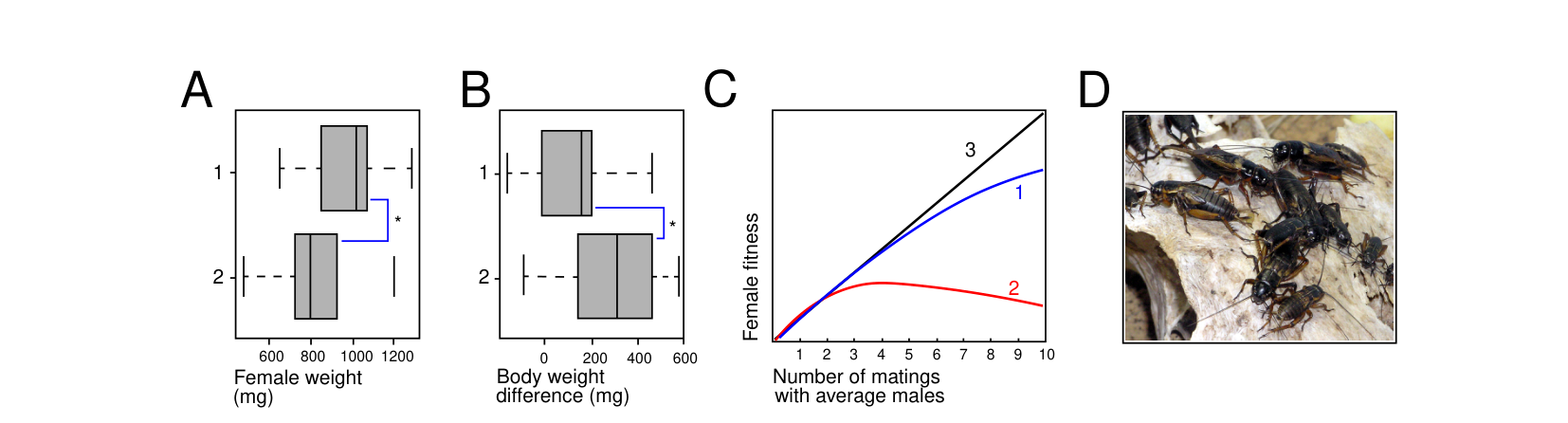 *Figure 1. A Female weight influence on mating outcome: copulated (1) and not copulated (2). B Body weight difference influence on male fighting outcomes: male winning (1) and male losing (2); median – solid line, boxes show 25% and 75% quartiles, p < 0.05. C Three hypothetical relationships between female fitness and the number of matings. Line 3 shows a system with an idealized relationship between female fitness and the number of matings. D G. bimaculatus.
On your answer sheet, indicate if the following statements are True (T) or False (F) based on the data provided.
Question reproduced from IBO 2024, Theoretical Exam Part B, licensed under CC BY-NC-SA 4.0 - attributed to the International Biology Olympiad. Open the full exam PDF