Q21 - Cannibalism Probability and Injury Bias in Japanese Mitten Crabs
Japanese mitten crabs, Eriocheir japonica, can display cannibalistic behavior. The absence of other food resources can greatly facilitate cannibalism. As a result of this, some crabs might be injured or killed. Injury level is not limited to the number of lost extremities but also includes any other forms of it. Figure 1 (A,B) displays the probability of cannibalism versus Factor S:
$$\text{Factor } S = 1 - \frac{\text{prey size}}{\text{predator size}}$$
Figure 1-D shows hypothetical results.
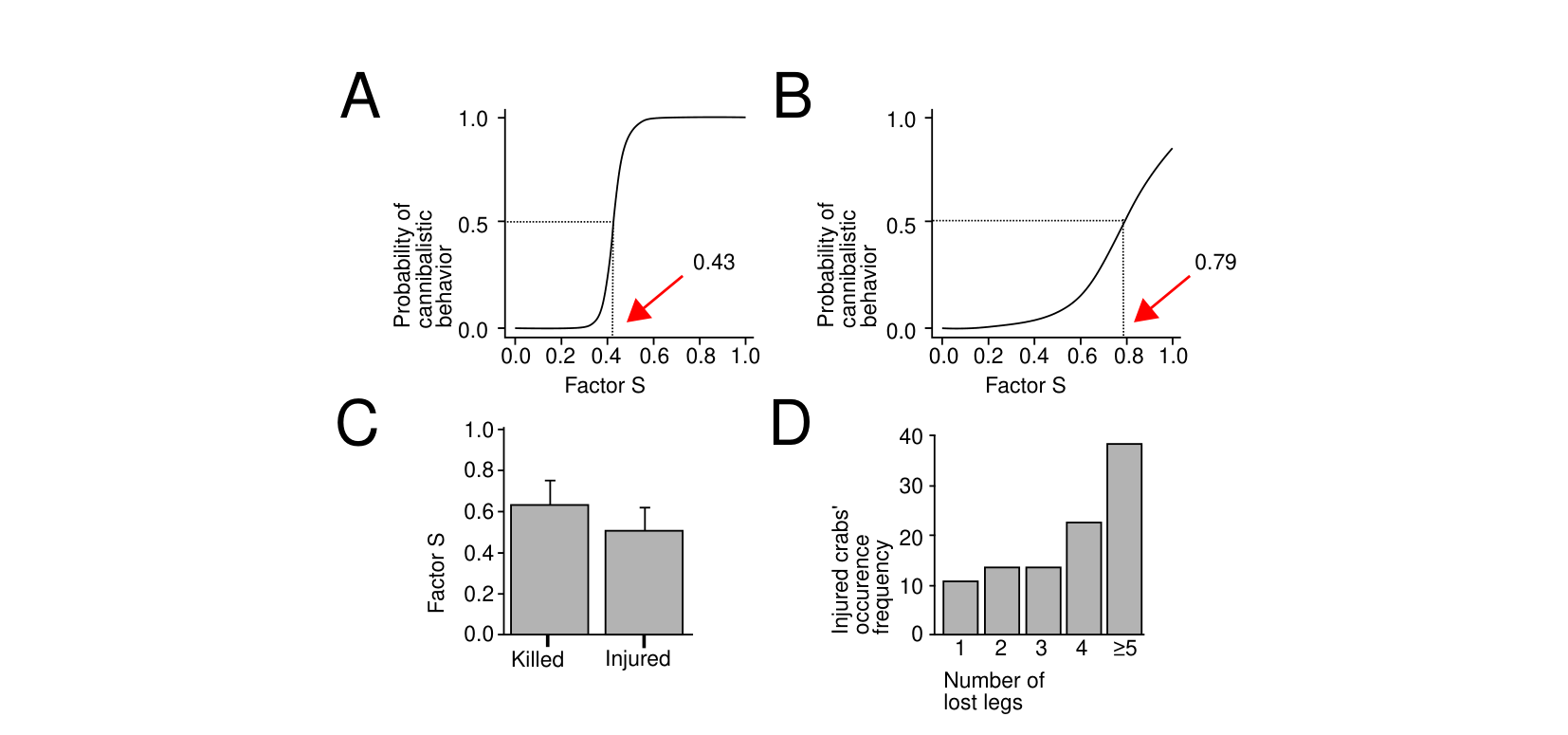 *Figure 1. A,B Cannibalism among only male (graph A) and only female (graph B) crabs, n-number of crabs. C Y – mean (+SD) of Factor S among killed and injured groups, p<0.05. D Injured crabs’ occurrence frequencies.
On your answer sheet, indicate “T” for true statements and “F” for false ones.
Question reproduced from IBO 2024, Theoretical Exam Part B, licensed under CC BY-NC-SA 4.0 - attributed to the International Biology Olympiad. Open the full exam PDF