Q34 - GAPLESS Proteins and Apoplastic Transport in Roots
Scientists studied how GAPLESS proteins affect apoplastic transport (transport through cell walls and extracellular space) of nutrients via the endodermis. First, they monitored the penetration of red dye into roots by examining cross-sections at two different positions (depicted as A and B in Figure 1) from the same root of a wild-type plant. Next, they analyzed how GAPLESS proteins affect red dye penetration into roots (Figure 2). In both figures, yellow arrows indicate an endodermal cell layer.
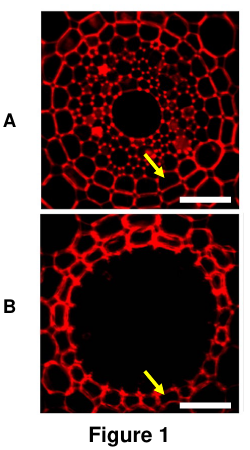 Figure 1. Cross-sections of a wild-type root at position A (top) and position B (bottom), each with the endodermal cell layer marked by a yellow arrow. Scale bars shown in white.
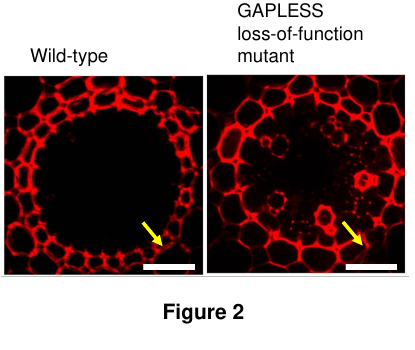 Figure 2. Red dye penetration in wild-type versus GAPLESS loss-of-function mutant root cross-sections, both taken at the position-B level. Yellow arrows indicate the endodermal cell layer. Scale bars shown in white.
On your answer sheet, indicate “T” for true statements and “F” for false ones.
Question reproduced from IBO 2024, Theoretical Exam Part B, licensed under CC BY-NC-SA 4.0 - attributed to the International Biology Olympiad. Open the full exam PDF