Q46 - Osmotic and Chemical Stress in a Marine Tardigrade
Echiniscoides sigismundi, a marine tardigrade, can change its activity level and morphology when exposed to osmotic and chemical stress. To study this, a series of experiments with different environmental conditions was conducted, and the tardigrades’ activity levels were measured. Each experiment consisted of three time periods (24 hours each) during which the environmental changes were applied (Figure 1, panels A–H).
Osmotic conditions used: ultrapure water (~0‰), saturated seawater (~240‰), and natural habitat seawater (Lsw). Chemicals used: DNP - a mitochondrial uncoupling agent. In some cases osmotic and chemical conditions were applied together (e.g. DNP(~240‰) means DNP + saturated seawater).
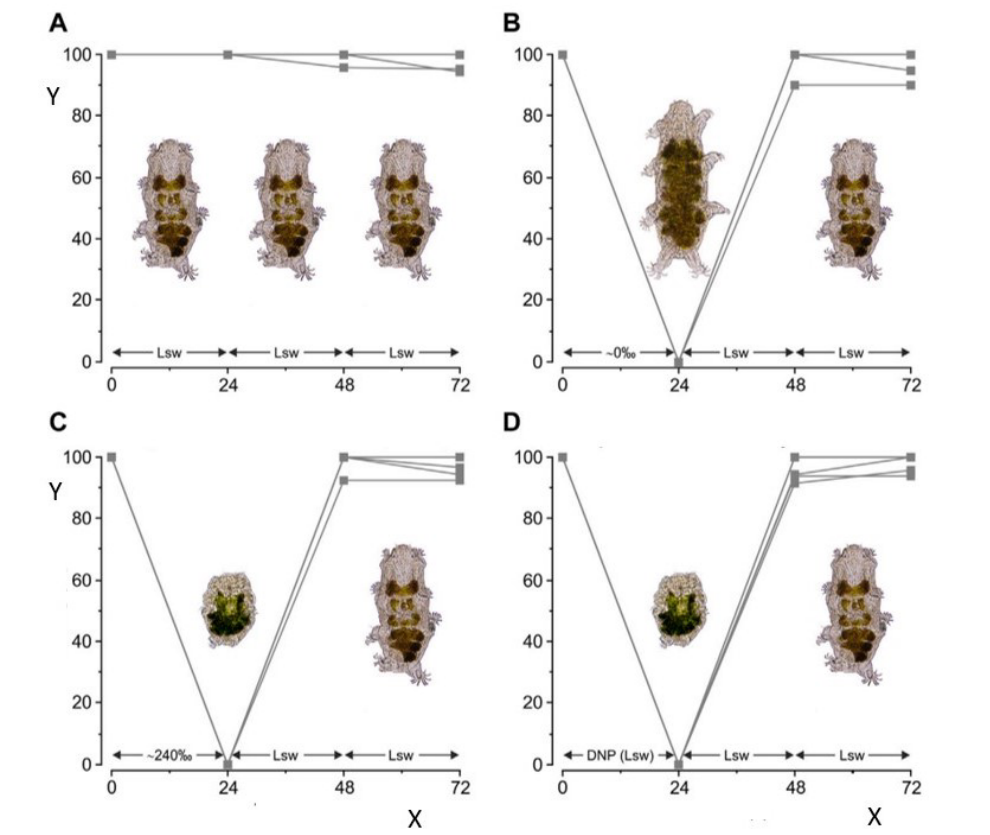 Figure 1 (panels A–D). X - time (h), Y - activity (%). Panel A: natural seawater (Lsw) throughout. Panel B: ~0‰ (ultrapure water) from 0–24h, then Lsw. Panel C: ~240‰ (saturated seawater) from 0–24h, then Lsw. Panel D: DNP(Lsw) from 0–24h, then Lsw. All activity levels at t = 72h in panels B, C, D are not significantly different from panel A.
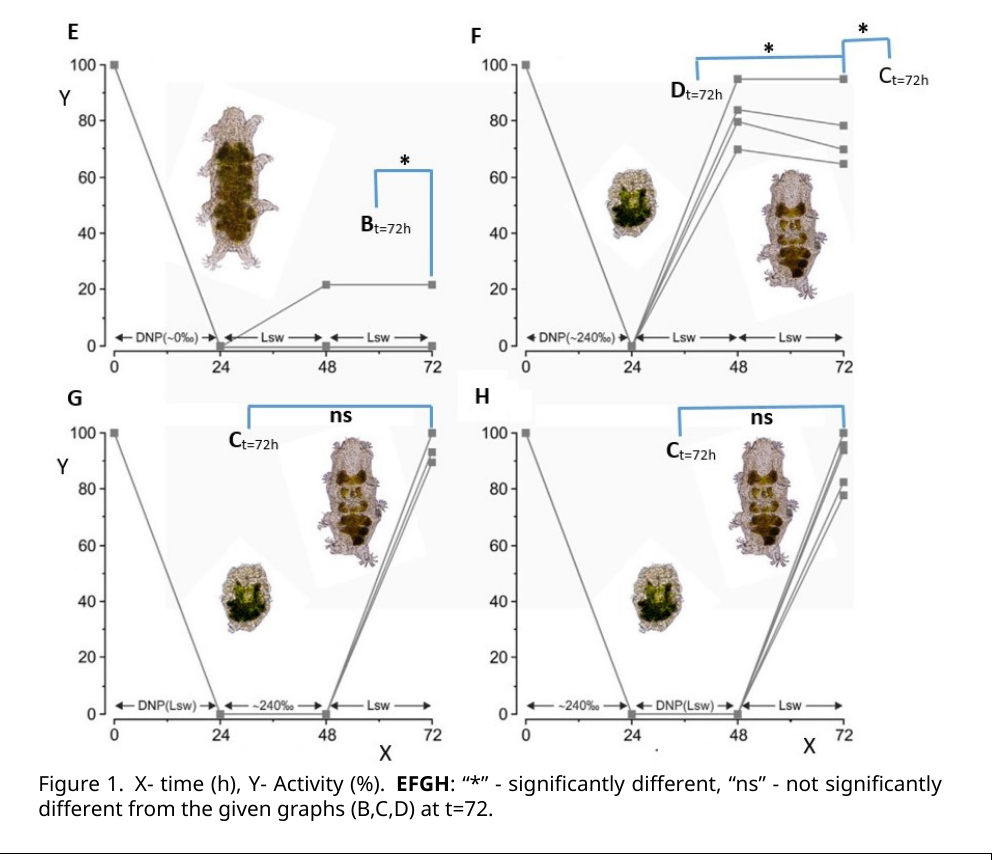 Figure 1 (panels E–H, continued). X - time (h), Y - activity (%). Panel E: DNP(~0‰) from 0–24h, then Lsw. Panel F: DNP(~240‰) from 0–24h, then Lsw. Panel G: DNP(Lsw) from 0–24h, then ~240‰, then Lsw. Panel H: ~240‰ from 0–24h, then DNP(Lsw), then Lsw. “” - significantly different, “ns” - not significantly different from the corresponding graphs (B, C, D) at t = 72h.*
On your answer sheet, indicate “T” for true statements and “F” for false ones.
Question reproduced from IBO 2024, Theoretical Exam Part B, licensed under CC BY-NC-SA 4.0 - attributed to the International Biology Olympiad. Open the full exam PDF