Q21 - Cholera Toxin Signaling and a CFTR Inhibitor Treatment
Cholera is caused by a toxin secreted by the bacterium Vibrio cholerae (Fig. A). One symptom is severe diarrhea, which leads to dehydration and perhaps death. Scientists tested a new CFTR-inhibitor, CFTR-172 (Fig. B) as a potential treatment for cholera. A, action of cholera toxin on an intestinal epithelial cell. GM1 (GM1 ganglioside receptor); Gs (G protein); AC (adenylate cyclase); Gi (G protein); cAMP (cyclic AMP); and CFTR (cystic fibrosis transmembrane conductance regulator Cl- channel); B, dose-dependent reaction of cholera toxin-induced fluid secretion into closed loops of mouse ileum as a function of applied CFTR-172 dose. After the 2010-earthquake in Haiti, a cholera outbreak led to discussions about the origin of the epidemic (Fig. C). Two theories were proposed: Either the infection originated from similar cases in Peru, or UN-soldiers from near Bangladesh carried it to the island, when they came to help after the earthquake. C, five variants of the cholera enterotoxin subunit B open reading frame. “Yellow” loci differ from “red” loci. Labels tell where each variant has caused cholera.
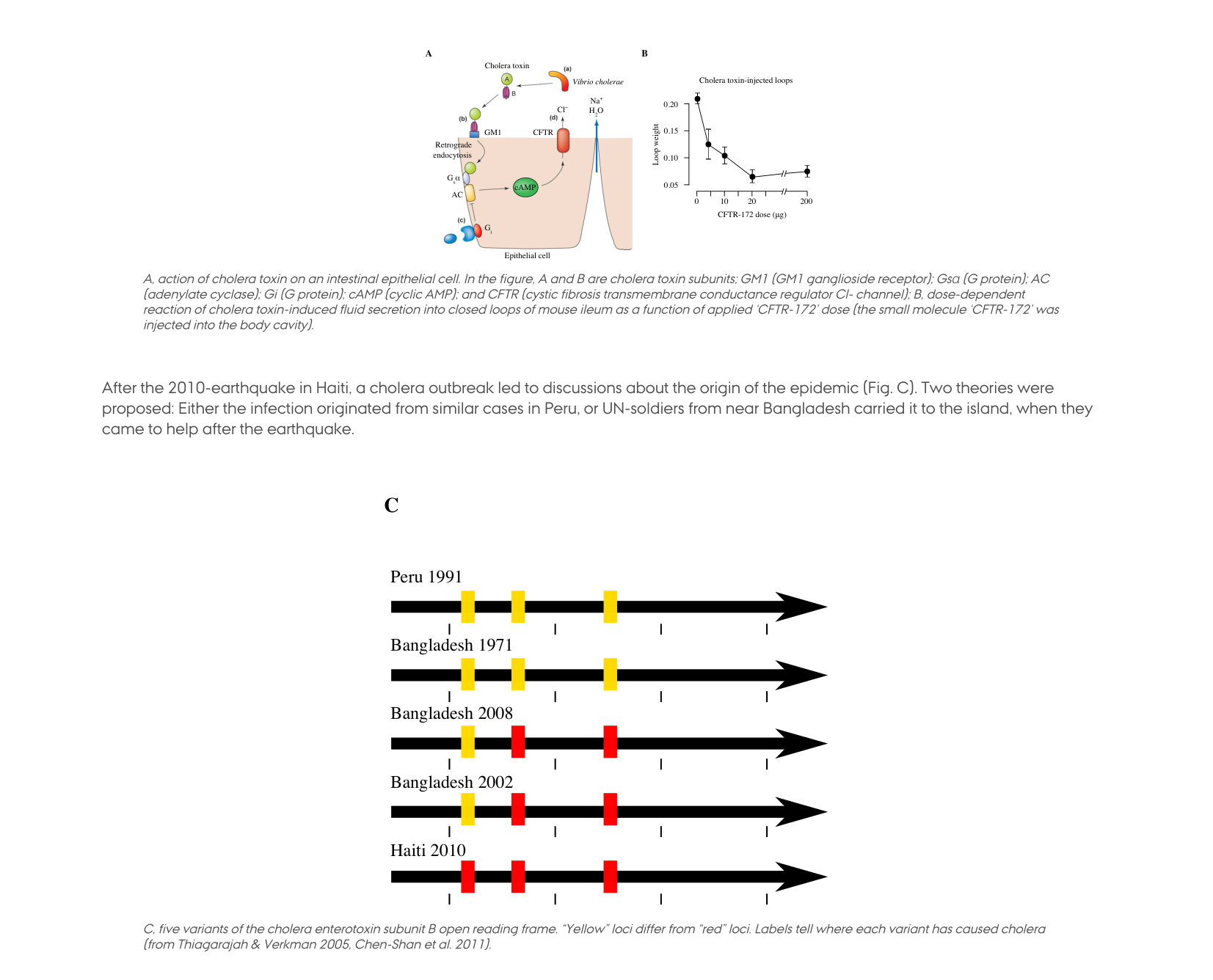 Figure 1.
Using the information and data, determine which of the statements are true or which are false.
Question reproduced from IBO 2015, Theoretical Exam A, licensed under CC BY-NC-SA 4.0 - attributed to the International Biology Olympiad. Open the full exam PDF · Community solutions (unofficial)