Q17 - Mating-Type Switching in Budding Yeast
Yeast (Saccharomyces cerevisiae) has a mating pattern with both haploid and diploid cells, mitosis and meiosis, and two kinds of mating types. Haploid cells may even switch mating type (Fig.).
A, mating-type switching in budding yeast (M, mother cell; D, daughter cell. a and α, mating types). Fig. A I. mitosis in haploids; A II: mating and diploid formation; B, budding in haploid yeast. Both in Fig. A and B, green filling indicates the repressor factor protein Ash1p.
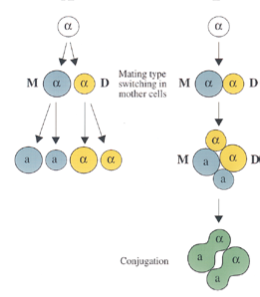 Figure 1.
Using the information and data, determine which of the statements are true or which are false.
Question reproduced from IBO 2015, Theoretical Exam B, licensed under CC BY-NC-SA 4.0 - attributed to the International Biology Olympiad. Open the full exam PDF · Community solutions (unofficial)