Q52 - Telomere Shortening in Fission-Yeast Telomerase Mutants
You identified a gene in fission yeast, homologous to a telomerase subunit from a protozoan. You then make a targeted deletion of one copy of the gene in a diploid strain of the yeast and then induce sporulation to produce haploid organisms. All four spores germinate perfectly, and you are able to grow colonies on nutrient agar plates. Every 3 days, you re-streak colonies onto fresh plates. After four such serial transfers, the descendants of two of the original four spores grow poorly, if at all. You take cells from the 3-, 6-, and 9-day master plates, prepare DNA from them, and cleave the samples at a chromosomal site about 35 nucleotides away from the start of the telomere repeats. You separate the fragments by gel electrophoresis, and hybridize them to a radioactive telomere-specific probe (dark bands) (Fig.Q.52). Assume that generation time is 6 hours.
Figure Q.52 Analysis of telomeres from descendants of four fission-yeast spores (S1-S4) at different days (t). WT is the normal diploid yeast.
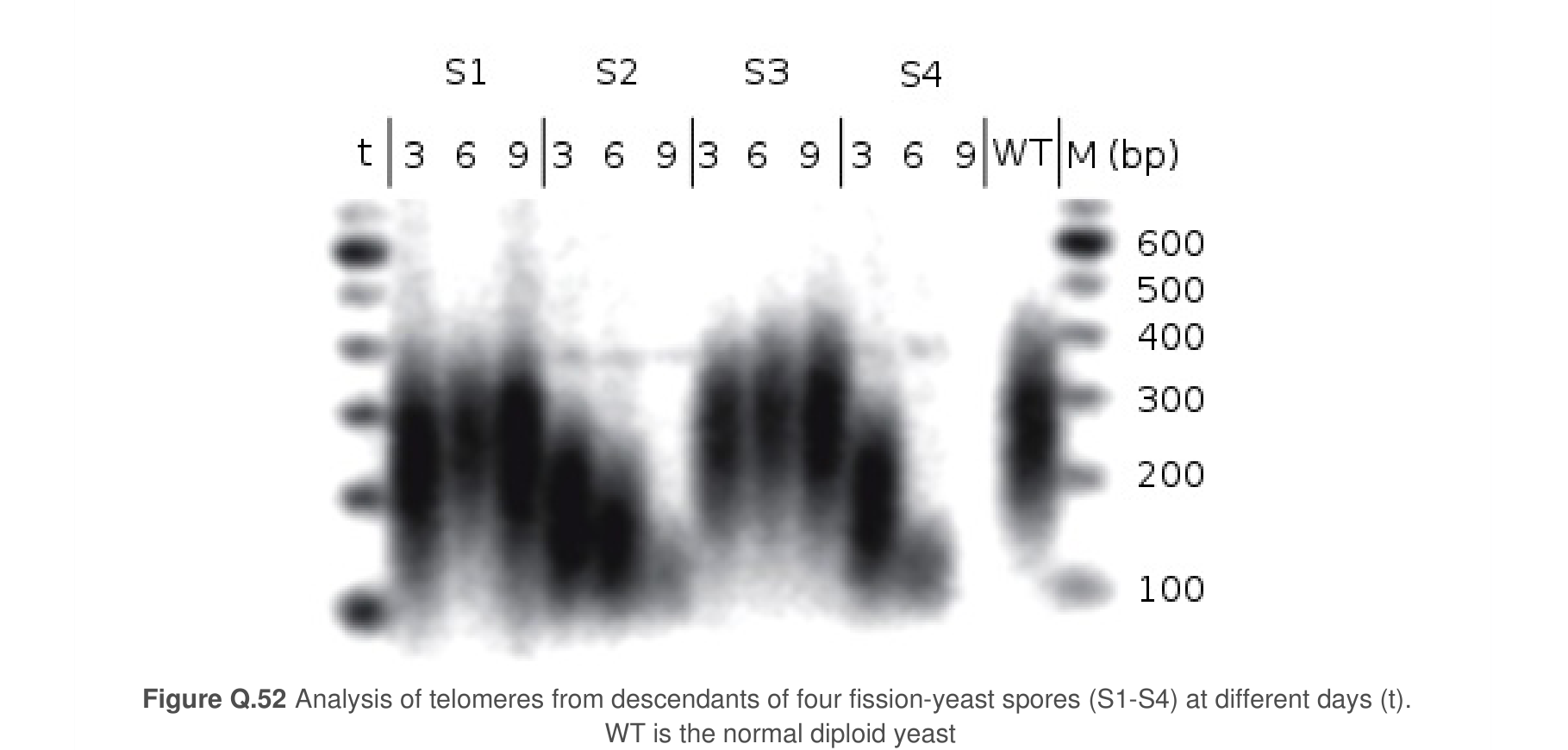 Figure 1.
Using the information and data, determine which of the statements are true or which are false.
Question reproduced from IBO 2016, Theoretical Paper B, licensed under CC BY-NC-SA 4.0 - attributed to the International Biology Olympiad. Open the full exam PDF · Community solutions (unofficial)