Q54 - Structure-Activity Relationships of Antifreeze Glycoproteins
Antifreeze glycoproteins (AFGPs) possess the ability to inhibit the formation of ice and are therefore essential to the survival of many marine teleost fishes that routinely encounter sub-zero temperatures. A typical AFGP consists of repeating tripeptide units, the alanyl-threonyl-alanyl (Ala-Thr-Ala)n unit connected to a disaccharide through a glycosidic bond at the second hydroxyl group of the threonine residue. To identify chemical groups which affect antifreeze activities of this glycoprotein, scientists synthesized numerous AFGP analogues by modifying both the structure of the sugar moieties and the peptide by replacing three groups R1, R2, R3 as shown in Fig.Q.54 with different chemical groups and recorded the antifreeze activity.
Figure Q.54 The structure of a typical AFGP
The results of the study are shown in the following table.
| R1 | R2 | R3 | Antifreeze activity |
|---|---|---|---|
| N-Acetyl | CH3 | Galactosyl | No |
| N-Acetyl | CH3 | Galactosyl | Yes |
| N-Acetyl | H | Galactosyl | No |
| N-Acetyl | CH3 | H | Yes |
| O-Acetyl | CH3 | H | No |
| N-Acetyl | CH3 | Galactosyl-Galactosyl | No |
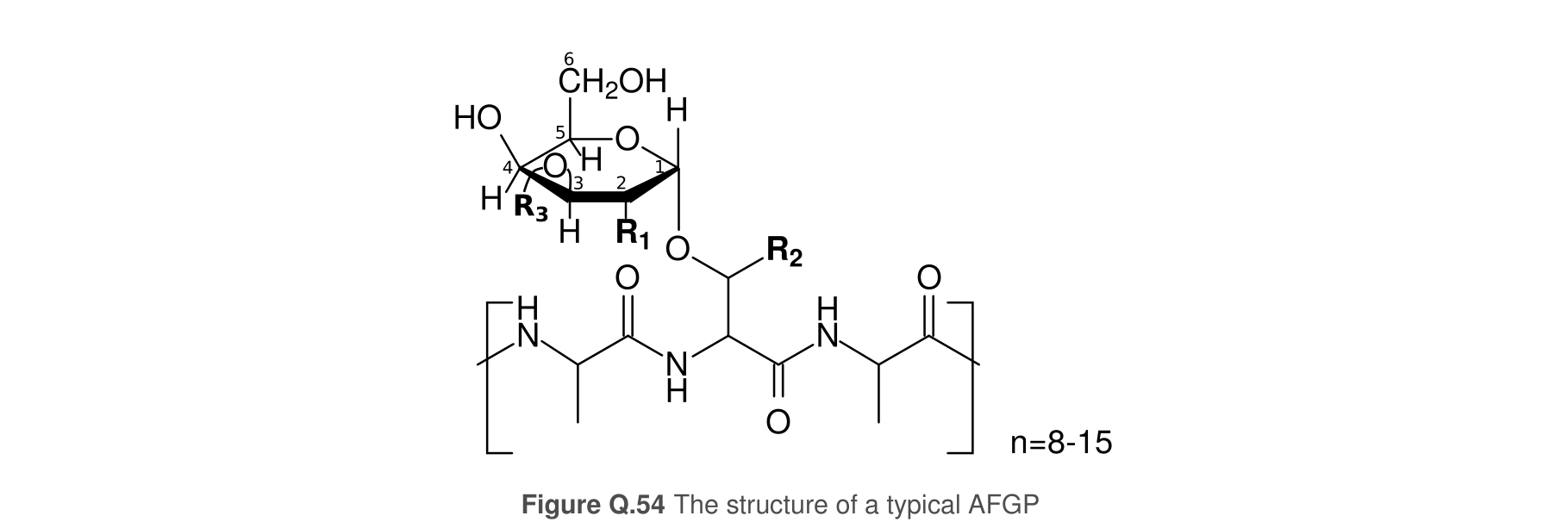 Figure 1.
Using the information and data, determine which of the statements are true or which are false.
Question reproduced from IBO 2016, Theoretical Paper B, licensed under CC BY-NC-SA 4.0 - attributed to the International Biology Olympiad. Open the full exam PDF · Community solutions (unofficial)