Q13 - Beta-Clamp Processivity in DNA Polymerase III
DNA polymerase III holoenzyme consists of the pol III* and the beta-clamp which hold pol III* and DNA template together. You are investigating whether during lagging strand synthesis, the pol III* synthesizing the lagging strand dissociates from the beta-clamp as it finishes one Okazaki fragment and re-associates with another beta-clamp to begin making the next Okazaki fragment. You prepared a primed M13phage (a single stranded DNA and a primer) template (M13mp18) as a donor and loaded a beta- clamp and pol III* onto it. As acceptors, you then added two more primed phage DNA templates, one (M13Gori) preloaded with a beta-clamp and the other (PhiX174) lacking a beta-clamp (Figure A). You incubated the templates together under replication conditions for 90 min - long enough for the donor and acceptors to be replicated - then performed gel electrophoresis (Figure B, lane 1-4). You then repeated the experiment but now loading a beta-clamp on PhiX174 instead of M13Gori (Figure B, lane 5-8).
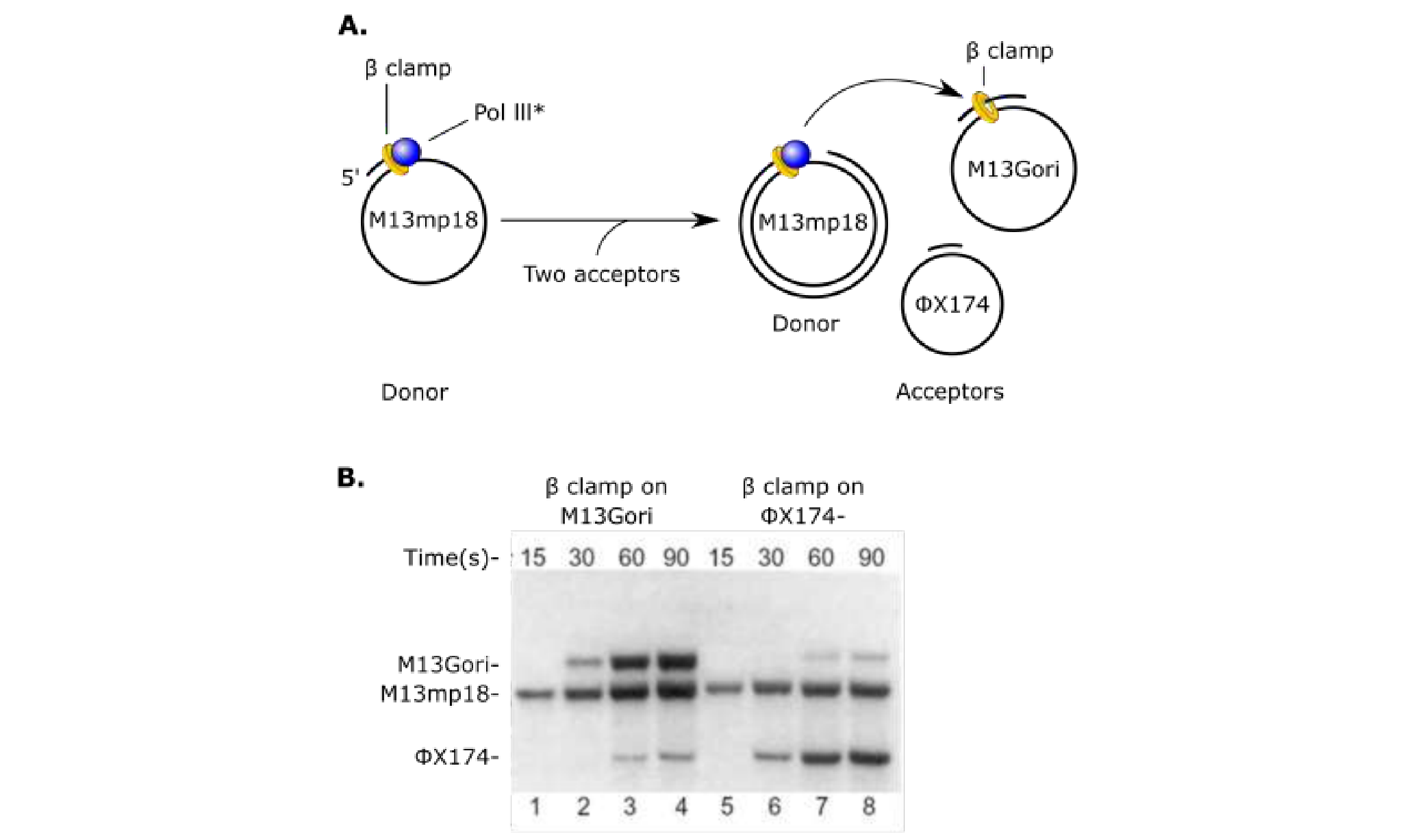 Figure 1.
Using the information and data, determine which of the statements are true or which are false.
Question reproduced from IBO 2018, Theoretical Paper 1, licensed under CC BY-NC-SA 4.0 - attributed to the International Biology Olympiad. Open the full exam PDF · Community solutions (unofficial)