Q10 - Yeast Secretion Trap Screen for Phytopathogen Secretomes
Phytopathogens use their secreted proteins “secretomes” to attack plant hosts. The yeast secretion trap (YST) functional screen is a method used for isolation and identification of these secreted proteins. This method involves generating a vector library that includes cDNAs (containing 5’ non-coding sequences) synthesized using phytopathogen RNAs fused to a mutated form of the Saccharomyces cerevisiae suc2 reporter gene. Suc2 encodes invertase which is the only protein used by yeast for sucrose degradation. Degradation occurs in the extra-cellular medium. The mutated form of the gene suc2-SP encodes an invertase that lacks the signal peptide for secretion at the amino terminal. The fusion library is used to transfect an invertase-deficient yeast strain, and the cells are subsequently plated on a sucrose selection medium. Each rescued cell is expected to contain a recombinant vector whose cDNA that encodes a signal peptide for the chimeric protein. Vectors are isolated and their cDNAs are sequenced to identify the secreted proteins. Figure 1 is a schematic presentation of the vector, and Figure 2 summarizes the protocol described above.
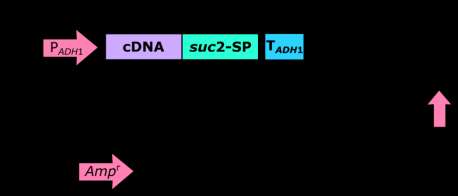 GAATTC: EcoR1 recognition site; GCGGCCGC: Not1 recognition site
Using the information and data, determine which of the statements are true or which are false.
Question reproduced from IBO 2018, Theoretical Paper 2, licensed under CC BY-NC-SA 4.0 - attributed to the International Biology Olympiad. Open the full exam PDF · Community solutions (unofficial)