Q38 - Bacterial Phyllody and the ABCE Model
The diagram below illustrates the ABCE model of flower development, in which the identity structure of floral organs of eudicots is regulated by floral homeotic genes divided into ABCE-classes, based on function: A- and E-class genes specify sepal identity; A-, B-, and E-class genes petal identity; B-, C-, and E-class genes stamen identity; and C- and E-class genes carpel identity. ABCE-class MADS domain transcription factors (MTFs) are key regulators of floral organ development in eudicots. Aberrant expression of these genes can result in abnormal floral traits, such as phyllody. Certain plant pathogenic bacteria could trigger phyllody in particular species, such as Petunia, which is shown in the figures below. A-E are parts of a control flower and F-I are parts of a bacteria-treated flower. The same parts of the flowers are shown in B and G, C and H, D and I, and E and J.
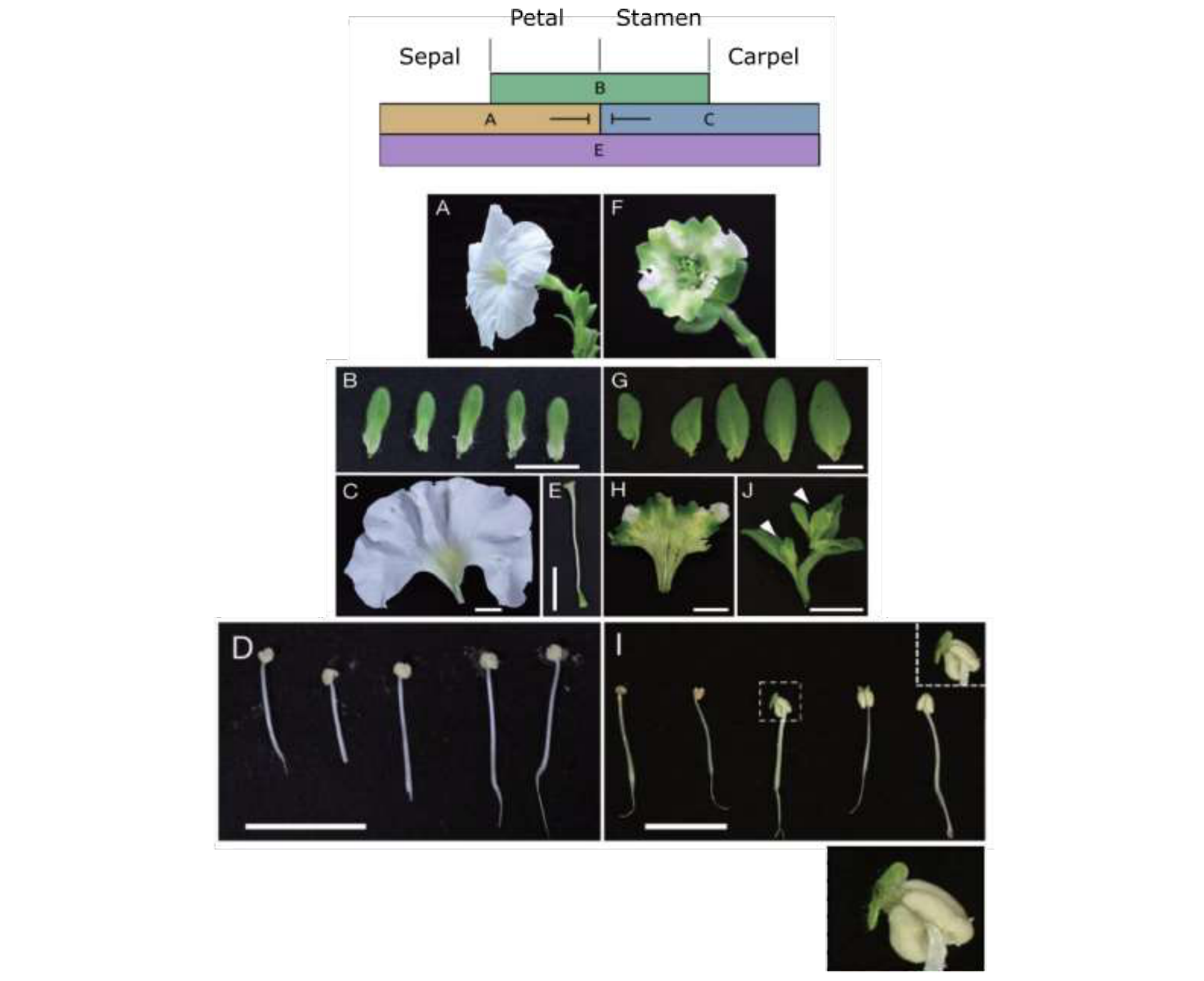 Figure 1.
Using the information and data, determine which of the statements are true or which are false.
Question reproduced from IBO 2018, Theoretical Paper 2, licensed under CC BY-NC-SA 4.0 - attributed to the International Biology Olympiad. Open the full exam PDF · Community solutions (unofficial)