Q37 - Why Bats Collide With Smooth Surfaces
Ethology
Twenty-eight rare and protected species of bat live in Hungary. Bats sense their environments using echolocation, which is disrupted by different surfaces. A smooth metal plate was attached to the wall as shown below. Bats were recorded attempting to drink from, or colliding with, the floor, walls, or the plate on the wall.
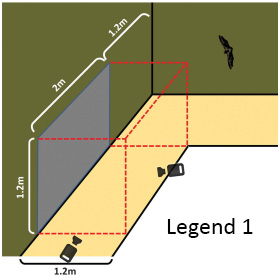 Fig.1. Legend 1 = High-speed cameras.
In a second experiment, the metal plate was instead placed on the floor, and bats were recorded attempting to drink from, or colliding with, the wall, floor, or the plate on the floor.
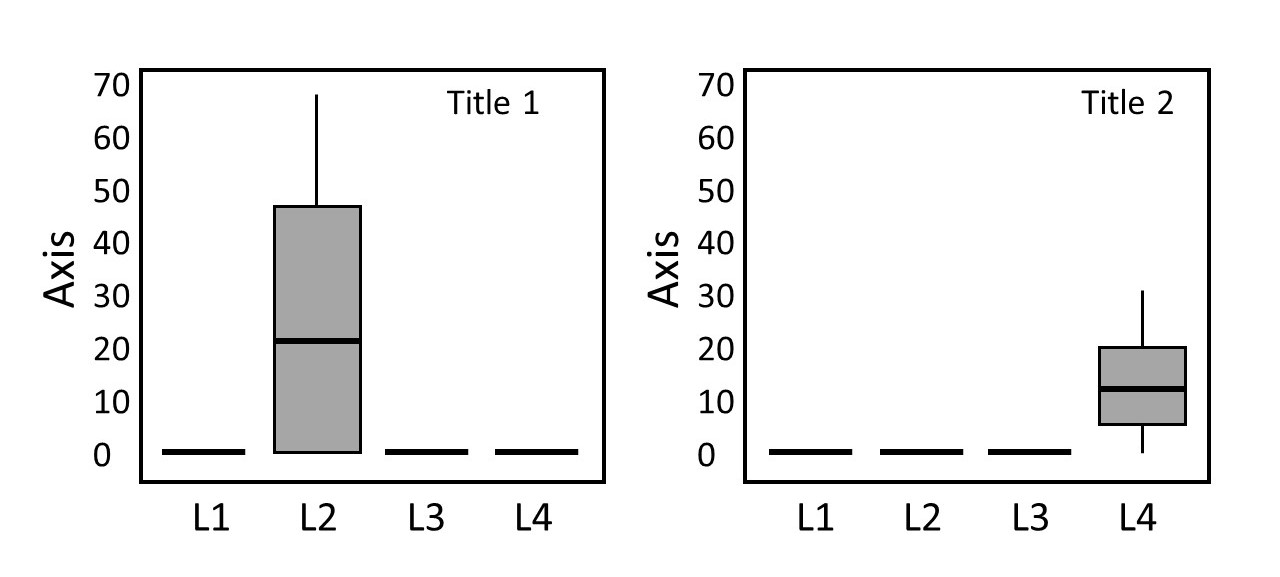 Fig.2. Percentage of drinking attempts and collision events in box plots. Values were calculated per individual relative to its total number of passes through the corridor. Title 1 = Horizontally placed metal plate. Title 2 = Vertically placed metal plate. Axis = Percentage of occurrence. L1 = drink from ground. L2 = drink from plate. L3 = collision with wall. L4 = collision with plate.
Why do bats react differently to smooth surfaces than to others? Indicate with an X if each of the following statements is true (T) or false (F).
Why do bats react differently to vertical and horizontal smooth surfaces? Indicate with an X if each of the following statements is true (T) or false (F).
Question reproduced from IBO 2019, Theoretical Exam A, licensed under CC BY-NC-SA 4.0 - attributed to the International Biology Olympiad. Open the full exam PDF · Official answer key