Q3 - Ethanol as a Competitive Inhibitor of Alcohol Dehydrogenase Acting on Methanol
Alcohol dehydrogenase is known to convert ethanol to acetaldehyde, which is eventually metabolized to CO2 and H2O in humans and many other organisms. The enzyme also catalyzes the conversion of methanol to poisonous formaldehyde, but with less efficiency. This normally means that ethanol is the physiological substrate for the enzyme. However, we may regard that ethanol is an efficient competitive inhibitor for the enzyme against the reaction with methanol under certain conditions. For example, intake of ethanol may prevent the conversion of methanol, when a small amount of methanol is taken up erroneously. Here, you can calculate the concentration of ethanol which suppresses 90% of the initial formaldehyde production in a test tube containing 5 mM methanol and alcohol dehydrogenase, based on the equations and assumption of kinetic constants of methanol and ethanol that are 10 mM and 1 mM, respectively. The initial velocity (v0) of methanol conversion can be obtained using equation 1: v0 = Vmax[S] / (alpha*KM + [S]). alpha is defined by equation 2: alpha = (1 + [I]/KI). [S]: the methanol concentration; KM: kinetic constant for methanol; [I]: the ethanol concentration; KI: the kinetic constant for ethanol.
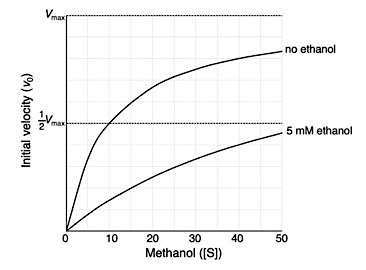 Figure 1.
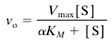 Figure 2.
 Figure 3.
Using the information and data, determine which of the statements are true or which are false.
Question reproduced from IBO 2020, Theoretical Exam 2, licensed under CC BY-NC-SA 4.0 - attributed to the International Biology Olympiad. Open the full exam PDF · Community solutions (unofficial)