Here is a mixture containing viruses, globular proteins, and cell nuclei, which are all assumed to have similar
densities of approximately 1.3 g/mL. We would like to separate them by using three different centrifugation
methods as shown in Figure 1. The first method entails centrifugation of the mixture (Mix) after placing it on
the top of a medium (Med) that has a uniform density (Exp. A). The second method (Exp. B) entails
centrifugation of the mixture using a medium that has a density gradient ranging from 1.0 to 1.6 g/mL (from the
top to the bottom). The final method entails the use of a centrifuge tube with the same density gradient as that
in Exp. B, but the mixture is placed at the bottom of the tube (Exp. C).
Figure 1.
Figure 2.
Figure 3.
Using the information and data, determine which of the statements are true or which are false.
Exp. A diagram. In Exp. A, how are viruses, globular proteins, and nuclei supposed to sediment? Choose the most appropriate diagram from Figure 2 that shows the sedimentation time courses of specimens.
Exp. A lines. In the selected diagram for Exp. A, indicate which line (a, b, or c) corresponds to viruses, globular proteins, and nuclei, respectively.
viruses = b, globular proteins = a, nuclei = c: Sedimentation speed at a shared density increases with particle size, and nuclei are much larger than viruses, which are in turn larger than individual globular proteins. In diagram III, line c falls fastest (steepest), line b is intermediate, and line a is slowest, so nuclei = c, viruses = b, and globular proteins = a.
Exp. B diagram. In Exp. B, how are viruses, globular proteins, and nuclei supposed to sediment? Choose the most appropriate diagram from Figure 2 that shows the sedimentation time courses of the specimens.
Exp. B lines. In the selected diagram for Exp. B, indicate which line (a, b, or c) corresponds to viruses, globular proteins, and nuclei, respectively.
viruses = b, globular proteins = a, nuclei = c: Larger particles move toward their equilibrium position faster even though all three specimens end up at the same final depth (since they share the same density). Nuclei (largest) reach equilibrium fastest, so nuclei = c (steepest early rise), viruses = b (intermediate), and globular proteins = a (slowest).
Exp. C diagram. In Exp. C, how are viruses, globular proteins, and nuclei supposed to float? Choose the most appropriate diagram from Figure 3 that shows the floating time courses of specimens.
Exp. C lines. In the selected diagram for Exp. C, indicate which line (a, b, or c) corresponds to viruses, globular proteins, and nuclei, respectively.
viruses = b, globular proteins = c, nuclei = a: Just as in Exp. B, larger particles move toward the shared equilibrium position faster, but now the movement is upward (floating) rather than downward. Nuclei (largest) rise fastest, matching line a's steep early rise in diagram VI, viruses are intermediate (line b), and the small globular proteins rise slowest (line c).
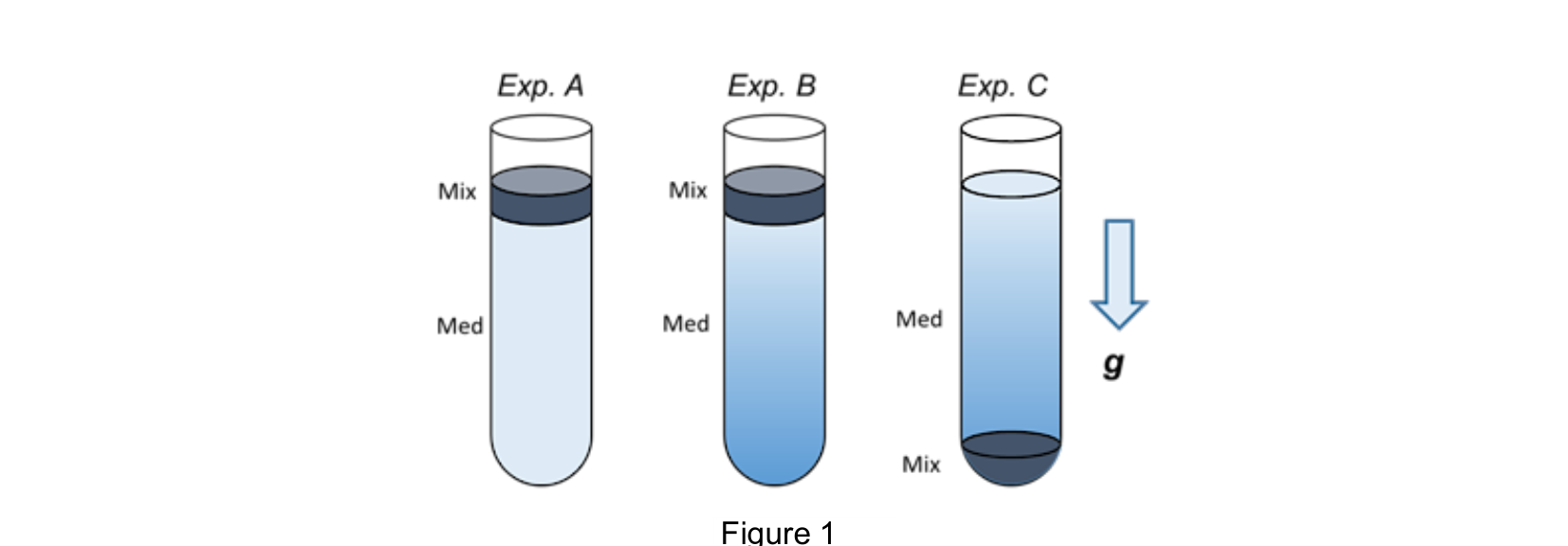 Figure 1.
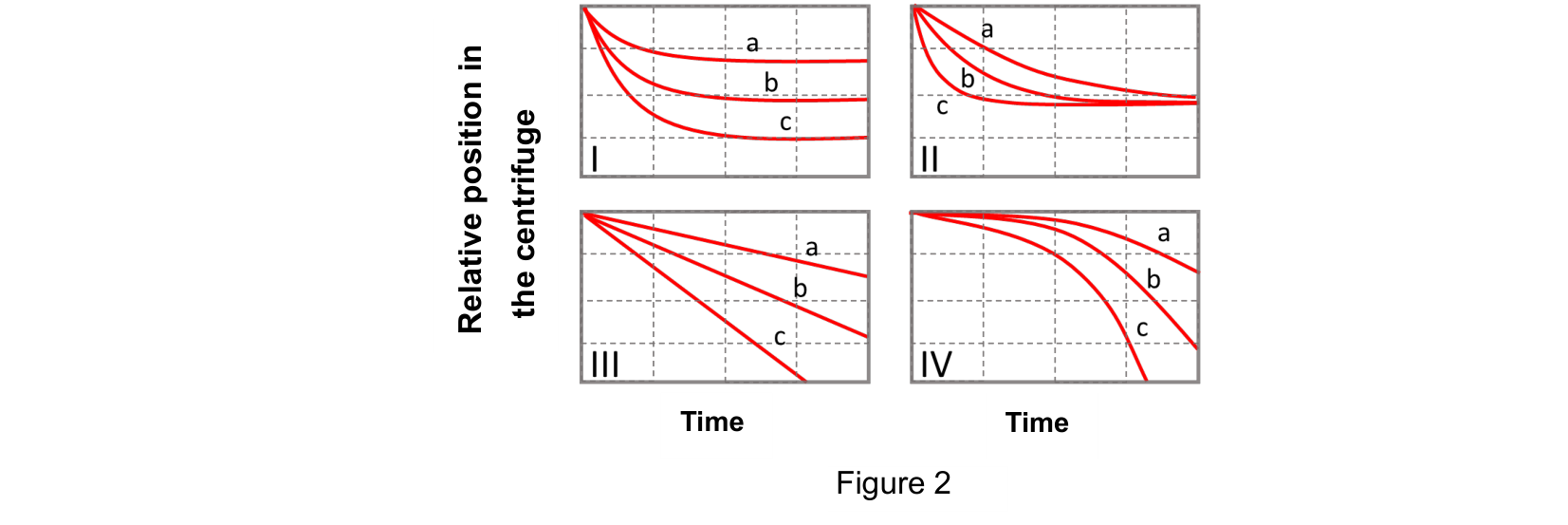 Figure 2.
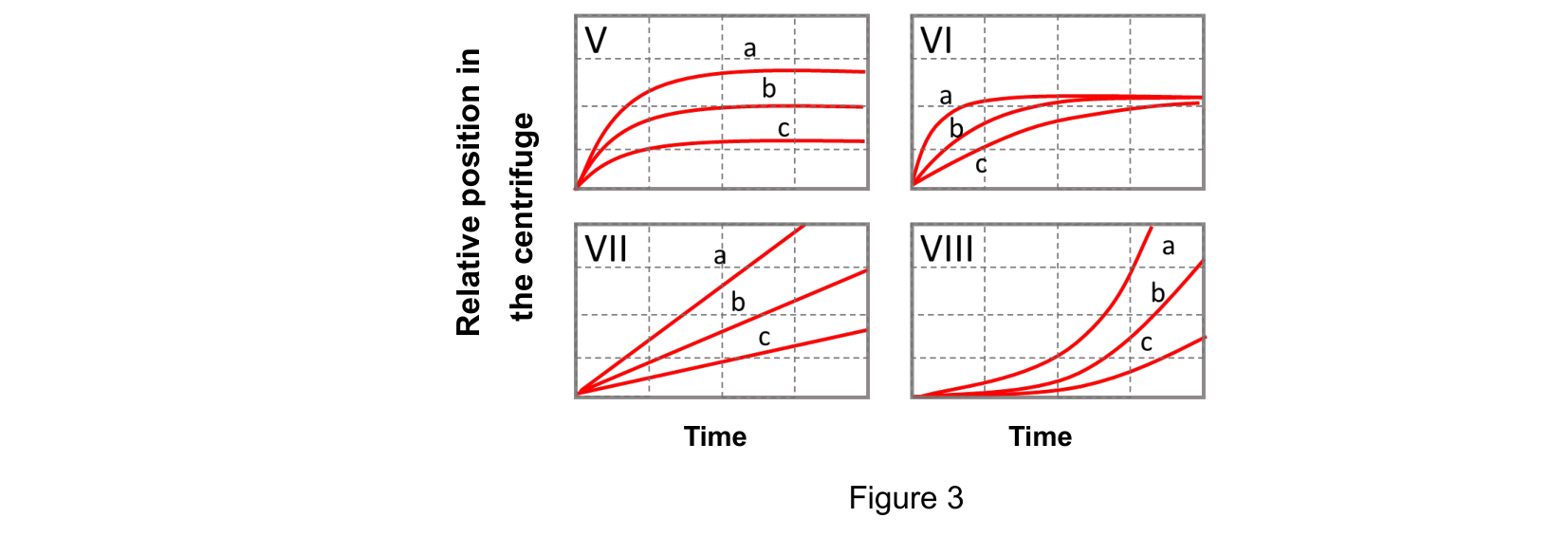 Figure 3.