Q11 - Heart Decellularization - Fish vs. Rat Cannulation
Decellularization is the process of isolating the extracellular matrix of a tissue from its inhabiting cells. Decellularization of organs is an important prerequisite for future transplantation of animal organs re-cellularized with the patient’s own cells. Heart decellularization can be performed by cannulating the coronary sinus (the venous sinus collecting blood from the heart) and perfusing it with a decellularization solution (a detergent that destroys cell membranes).
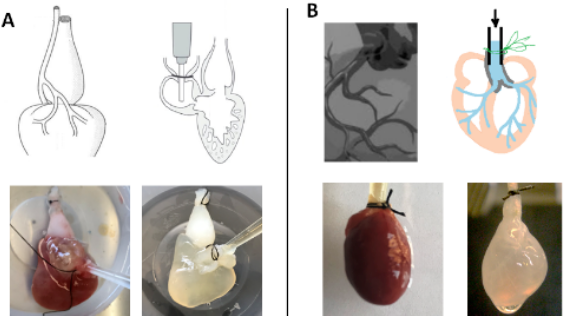 Figure 1. Cannulation process of fish (A) and rat (B) hearts - appearance right after cannulation and upon completion of decellularization.
Using the information and images, determine whether the following statements are true or false:
Question reproduced from IBO 2022, Theoretical Paper 1, licensed under CC BY-NC-SA 4.0 - attributed to the International Biology Olympiad. Open the full exam PDF · Community solutions (unofficial)