Q67 - Root Water Transport Pathways - Apoplast vs Symplast
Water that is absorbed by the roots of a plant, moves from the roots to the xylem. The figure shows these pathways in the root of Ranunculus acris.
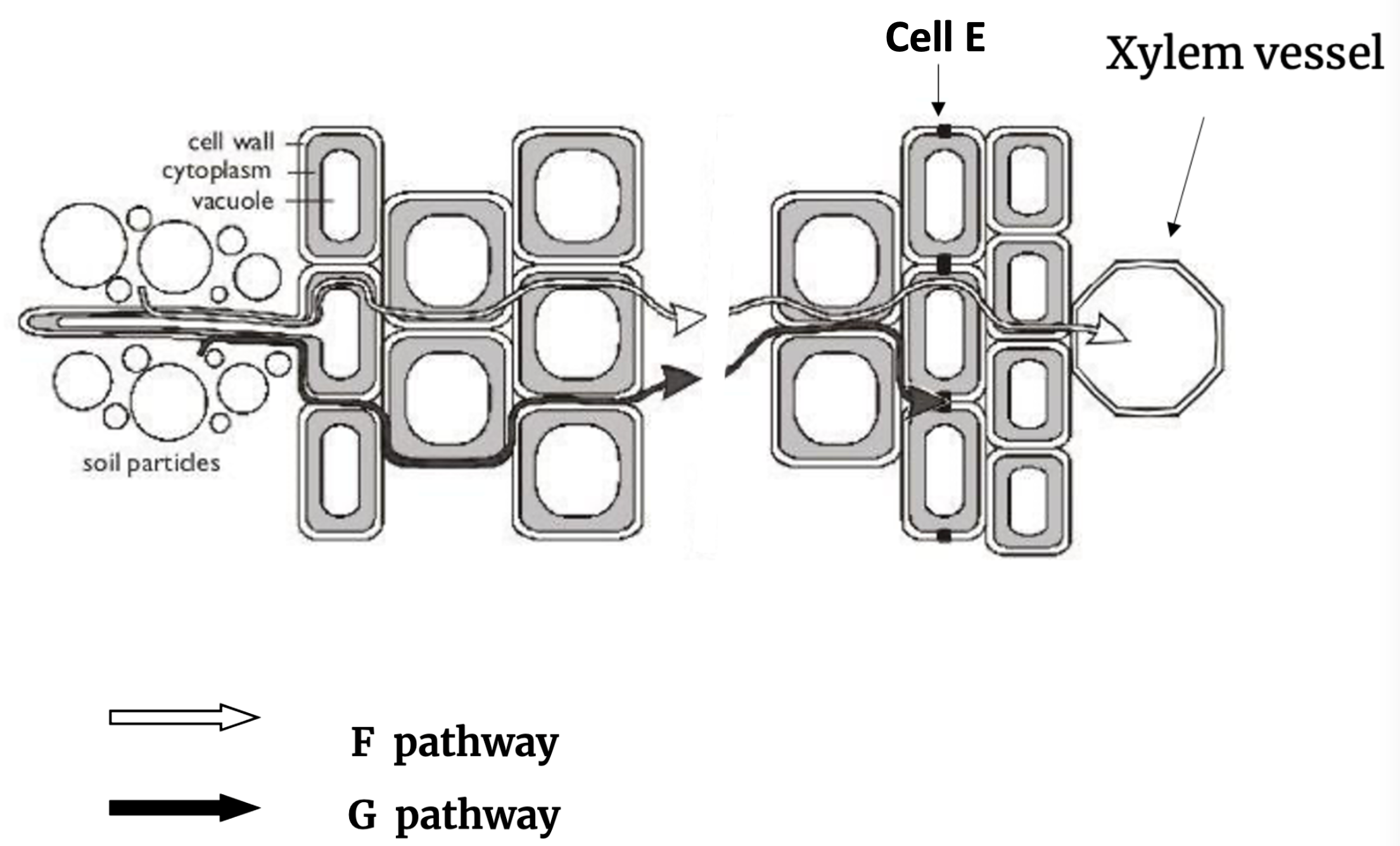 The F and G water-transport pathways through root cells of Ranunculus acris, converging at Cell E before reaching the xylem vessel.
Use the information and figure to determine whether the following statements are true or false.
A. Cell E regulates the entry of ions into the xylem vessels.
B. G pathway is the symplastic pathway
C. The movement of water along pathway F is slower than along pathway G.
D. Water can move from cell to cell only with the help of plasmodesmata.
Question reproduced from IBO 2022, Theoretical Paper 2, licensed under CC BY-NC-SA 4.0 - attributed to the International Biology Olympiad. Open the full exam PDF · Community solutions (unofficial)