Q68 - Pressure-Flow Model of Phloem Sucrose Transport
The picture shows the tissues involved in the transport of sucrose in plants: the sieve tube cells and the companion cells.
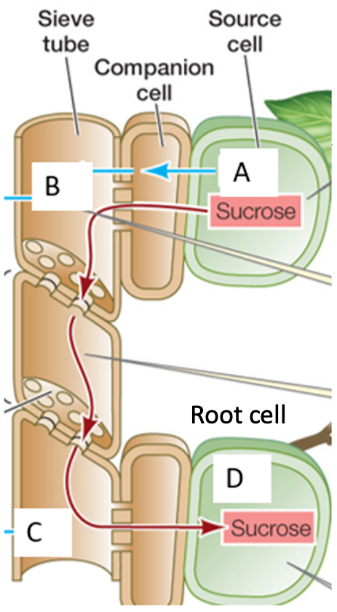 Sucrose loading at the source (cells A and B) and unloading at the sink (cells C and D) along the sieve tube–companion cell system.
Use the information and figures to determine whether the following statements are true or false.
A. The water potential in cell B is the highest
B. The concentration of sucrose in cell A is the highest
C. The difference in pressure potential is the driving force of the transport of sucrose along sieve cells.
D. Sucrose is transported from the mesophyll cell to B cell without energy expenditure
Question reproduced from IBO 2022, Theoretical Paper 2, licensed under CC BY-NC-SA 4.0 - attributed to the International Biology Olympiad. Open the full exam PDF · Community solutions (unofficial)