Q69 - Mechanosensitive Ion Channels - OSCA vs Piezo1
Mechanically activated channels (MA) transfer physical force into electrical current. Piezo1 is a well-characterized subtype of the MA channel. OSCA proteins have been described as sensing receptors that exist not only in mammals but various other eukaryotes like plants and flies. In order to understand the role of OSCA proteins to different stimuli, cells were treated with hyperosmolarity and cell stretching, and the electrical response was recorded. Cells expressing different OSCA variants, OSCA1.1 and OSCA1.2, were compared with Piezo1, in their electrical response, in the figure below.
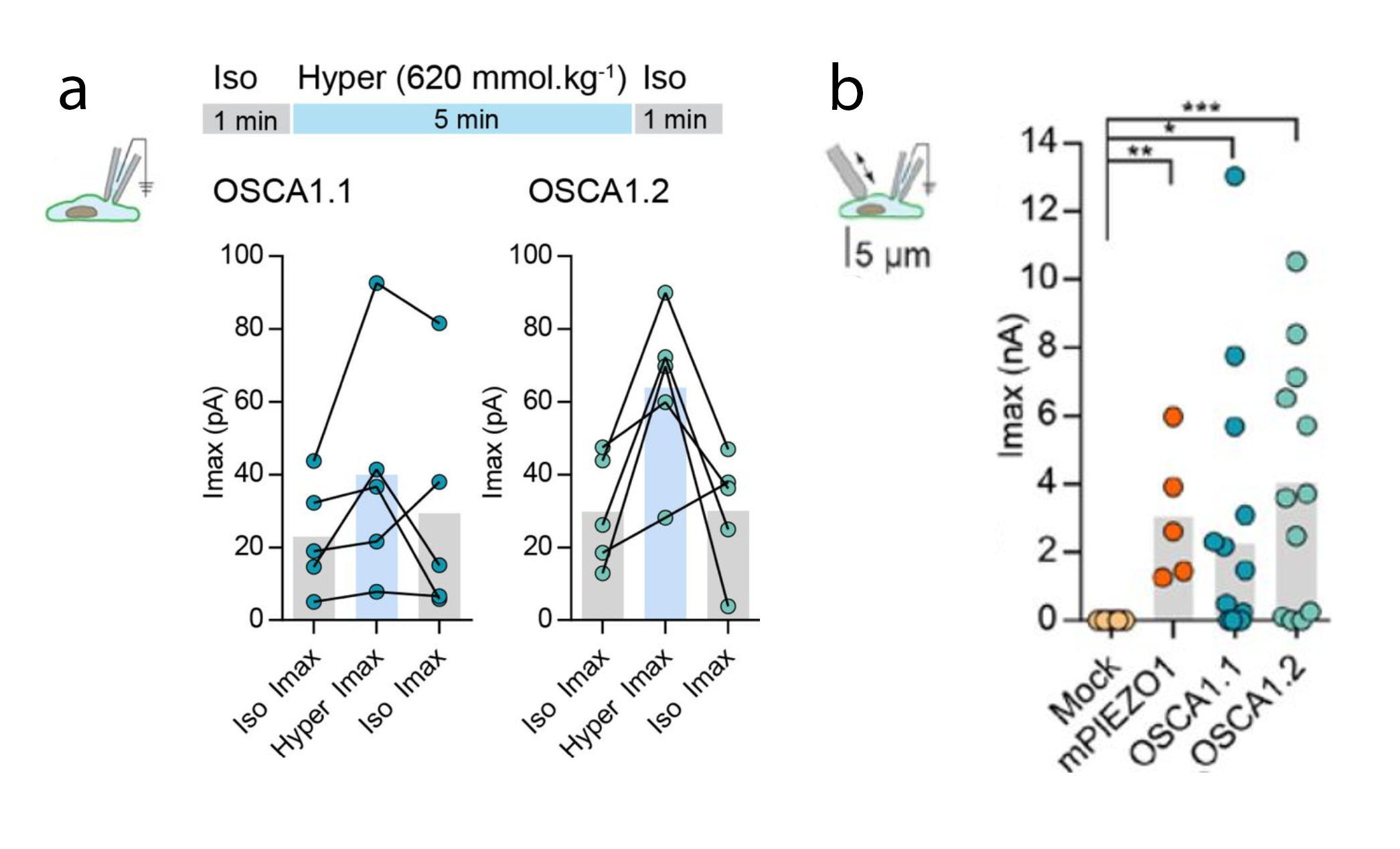 Figure 1. Left half (panel a): response to hyperosmolarity, recorded in picoamps. Right half (panel b): response to mechanical stretch stimuli, recorded in nanoamps, by patch-clamp recording. Imax is the current peak. Mock cells do not express any of these proteins, while PIEZO1, OSCA1.1 and OSCA1.2 cells were transfected to express the corresponding protein. Lines connect biological replicates.
Use the information and figures to determine whether the statements are true or false.
Question reproduced from IBO 2022, Theoretical Paper 2, licensed under CC BY-NC-SA 4.0 - attributed to the International Biology Olympiad. Open the full exam PDF · Community solutions (unofficial)