Skip to content
📢We are still a growing community and would love some help. Want to contribute? Join us by mailing an e-mail of interest to "r6394175@gmail.com"
Start helping our community →
← Theoretical 2

Q77 — Mitochondrial Calcium Handling in Synaptic Plasticity and Aging

Theoretical 2 Real exam question — full text reproduced under IBO's CC BY-NC-SA 4.0 license

Synaptic plasticity in the adult brain underlies the cellular mechanisms of learning and memory. Mitochondria contribute to the process of synaptic plasticity. The figure shows the regulatory role of mitochondria in the functions and plasticity of synapses, as well as the effect of mitochondrial dysfunction on synaptic transmission (solid lines show excitatory processes, dotted lines show inhibitory processes).
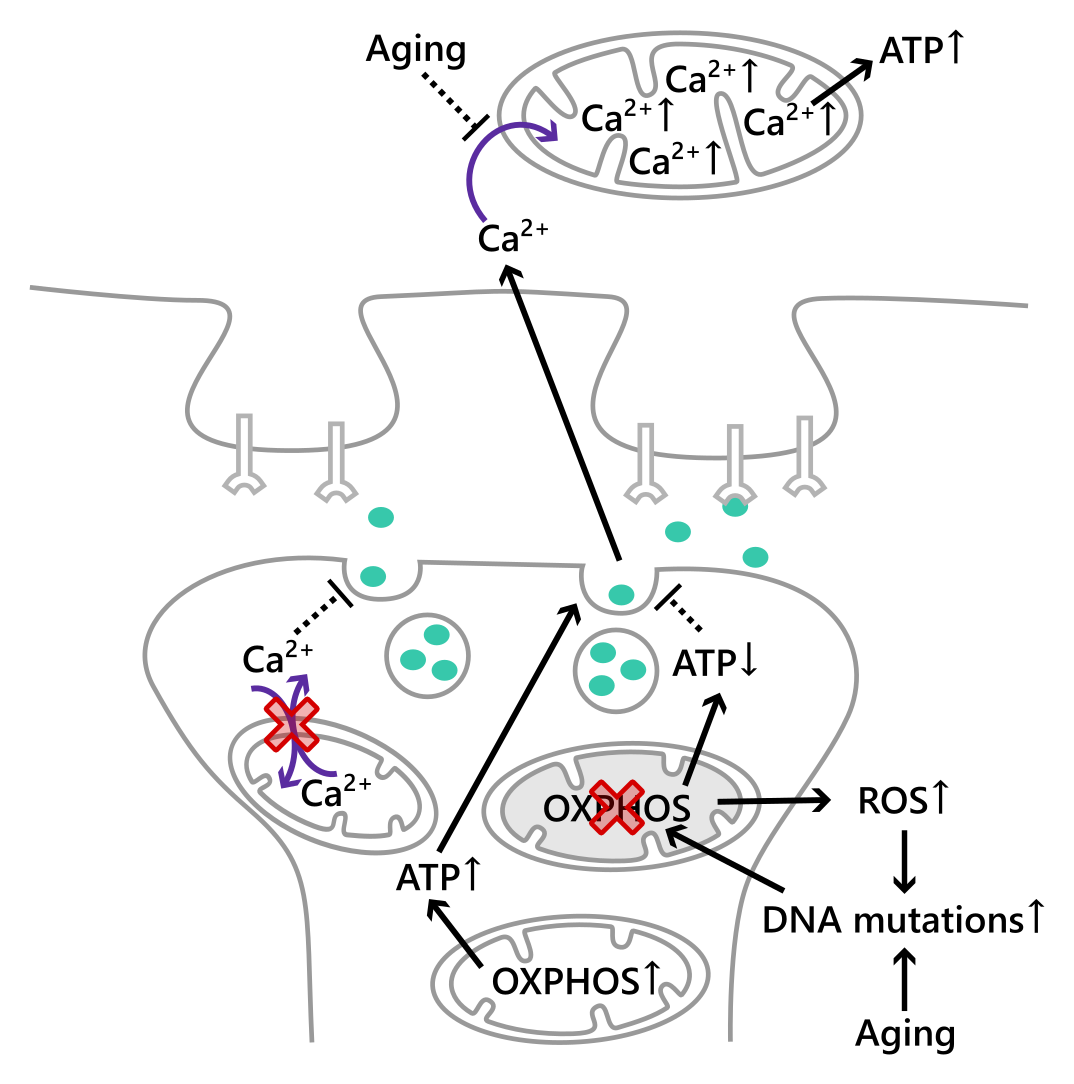
Diagram of a synapse showing a presynaptic terminal with two mitochondria: one with normal Ca2+ exchange promoting ATP↑ that supports vesicle release, and one where mitochondrial Ca2+ exchange is blocked (marked with a red X), which inhibits vesicle release. A second presynaptic mitochondrion shows aging-related OXPHOS deficiency lowering ATP (ATP↓), which inhibits vesicle release, while OXPHOS deficiency also raises ROS, which causes DNA mutations that feed back into further mitochondrial damage — a cycle driven by aging. On the postsynaptic side, a dashed inhibitory line from “Aging” blocks Ca2+ entry into a postsynaptic mitochondrion that would otherwise raise Ca2+ and boost ATP production. Figure. Role of mitochondria in synaptic plasticity, and the effects of aging and mitochondrial DNA mutations on this regulation. OXPHOS = mitochondrial oxidative phosphorylation; ROS = reactive oxygen species.

Based on this diagram, determine whether the following statements are true or false.

A. The disruption of mitochondrial calcium exchange can block neurotransmitter release from vesicles.
B. The process of aging leads to blocking the entry of calcium into postsynaptic mitochondria, which, in turn, activates oxidative phosphorylation.
C. The process of aging suppress mitochondrial respiration, leading to increased release of neurotransmitters into the synaptic cleft.
D. Deficiency of components of the electron transport chain (ETC) may result in the accumulation of reactive oxygen species (ROS). Subsequently, high levels of ROS may cause DNA mutations, resulting in mitochondrial damage and further ETC deficiency.

Question reproduced from IBO 2022, Theoretical Paper 2, licensed under CC BY-NC-SA 4.0 — attributed to the International Biology Olympiad. Open the full exam PDF · Community solutions (unofficial)