Q78 - Cellular Response to DNA Damage in Cancer
Cell response to DNA damage is intricately regulated and can lead to different pathways. On one hand, cells try to repair the breaks in the DNA helix, on the other hand, they proceed to apoptosis and mitotic arrest, if it fails. Cancer cells are typically treated with DNA-damaging agents like irradiation and many chemotherapeutics lead to proliferation inhibition and ultimately cell death. To escape this fate, some cancer cells develop various resistance mechanisms that allow them to survive and proliferate further.
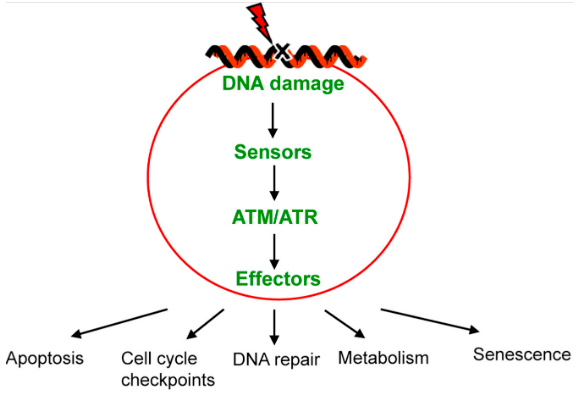 Diagram of the DNA damage response pathway: sensors, effectors, and the possible downstream outcomes (apoptosis, cell cycle checkpoints, DNA repair, metabolism, senescence).
Using this information, determine whether the following statements are true or false.
Question reproduced from IBO 2022, Theoretical Paper 2, licensed under CC BY-NC-SA 4.0 - attributed to the International Biology Olympiad. Open the full exam PDF · Community solutions (unofficial)