Q79 - Primary vs Secondary Antibody Response
It is known that the humoral immune system responds to antigens entering an organism by producing antibodies. The diagram shows the immune response (production of antibodies) during the initial (first) and repeated (secondary) introduction of the antigen. Note that the time from infection to the presence of a significant amount of antibody in the bloodstream is called a latent period.
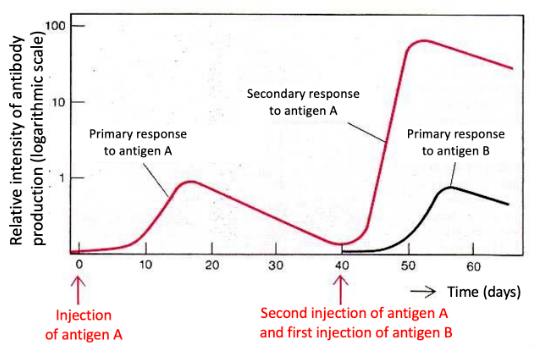 Relative intensity of antibody production (log scale) over time, showing the primary response to antigen A, the secondary response to antigen A after a second injection, and the primary response to antigen B given at the same time as the second injection of antigen A.
Using this information, determine whether the following statements are true or false.
Question reproduced from IBO 2022, Theoretical Paper 2, licensed under CC BY-NC-SA 4.0 - attributed to the International Biology Olympiad. Open the full exam PDF · Community solutions (unofficial)