Q80 - Dopamine and GABA Neuron Activity in Stress-Induced Anhedonia
One of the main symptoms of depression, which often develops after stress, is anhedonia, the loss of the ability to feel pleasure. Dopamine (DA) signals, which are sent to certain parts of the brain, play a key role in the pursuit of rewards, motivation for behavior and learning from positive experiences. One assumption is that stress leads to anhedonia through dopamine neurons, although little evidence is available to support this claim. Experiments were performed on mice to study the neurological mechanisms of anhedonia using the method of intracranial electroencephalography (iEEG), assessing the activity of dopaminergic (DA) and Gamma-Aminobutyric Acid (GABA) neurons. Mice in the experimental group (+stress) were rewarded with water after being exposed to stress. Mice in the control group were not exposed to stress. A sound stimulus (as a CS+) alerted mice to the reward of water.
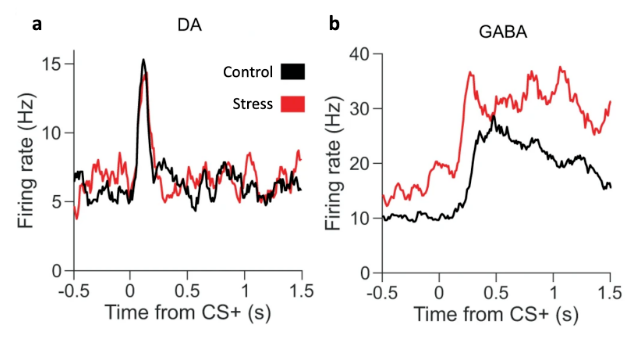 Figure 1. The activity of (a) DA neurons and (b) GABA neurons in the midbrain (firing rate in hertz) in response to a sound signal. Time 0 marks the onset of the CS+ sound signal. Black curve: control mice; red curve: experimental (stress) mice.
Using the information and the figures above, determine whether the following statements are true or false.
Question reproduced from IBO 2022, Theoretical Paper 2, licensed under CC BY-NC-SA 4.0 - attributed to the International Biology Olympiad. Open the full exam PDF · Community solutions (unofficial)