Q85 - The methuselah Mutation and Stress Resistance in Drosophila
Researchers used random insertion transposon mutagenesis to disrupt genomic DNA in fruit flies (D. melanogaster). One of the isolated mutants, called mth, was examined for longevity and stress resistance, compared to the wild type (+) under the influence of paraquat (an inducer of intracellular superoxide anion production), starvation and high temperature. Results of the experiments comparing homozygous mth mutants and the wild type (+) are summarized below.
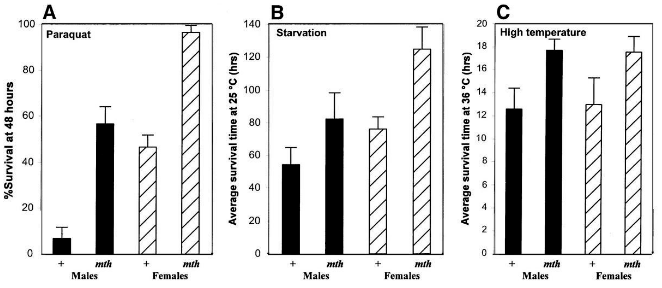 Survival of wild-type (+) and mth mutant Drosophila, males and females, under paraquat-induced oxidative stress, starvation, and high temperature.
Using the information and the data to determine which of the statements are true or which are false.
Question reproduced from IBO 2022, Theoretical Paper 2, licensed under CC BY-NC-SA 4.0 - attributed to the International Biology Olympiad. Open the full exam PDF · Community solutions (unofficial)