Q11 - Engineered Viral Capsids and Genome Packaging
Engineering proteins to have desired function and activity has been a long-standing goal of biotechnology.
In an experiment, researchers designed a minimal genome similar to that of a bacteriophage, which encodes two proteins. When expressed in the host Escherichia coli, multiple copies of these proteins assemble into an icosahedral package and sometimes encapsulate the genetic material within.
Three variations were designed:
- I53-50, which is known to assemble into an icosahedral structure,
- I53-50-v1, which was a mutated sequence of I53-50 (version 1),
- I53-50-Btat, which was generated by genetically inserting a naturally occurring nucleic acid binding peptide (Btat) to the interior-facing terminus of the capsid.
To test the viability of these engineered “viruses,” two experiments were performed. In the first experiment, the host bacteria were lysed and debris was removed, then put through affinity and size exclusion chromatography. The resulting material was treated with RNase and DNase enzymes and visualized on gel electrophoresis stained for protein, nucleic acid, and nucleic acid after addition of reverse transcriptase.
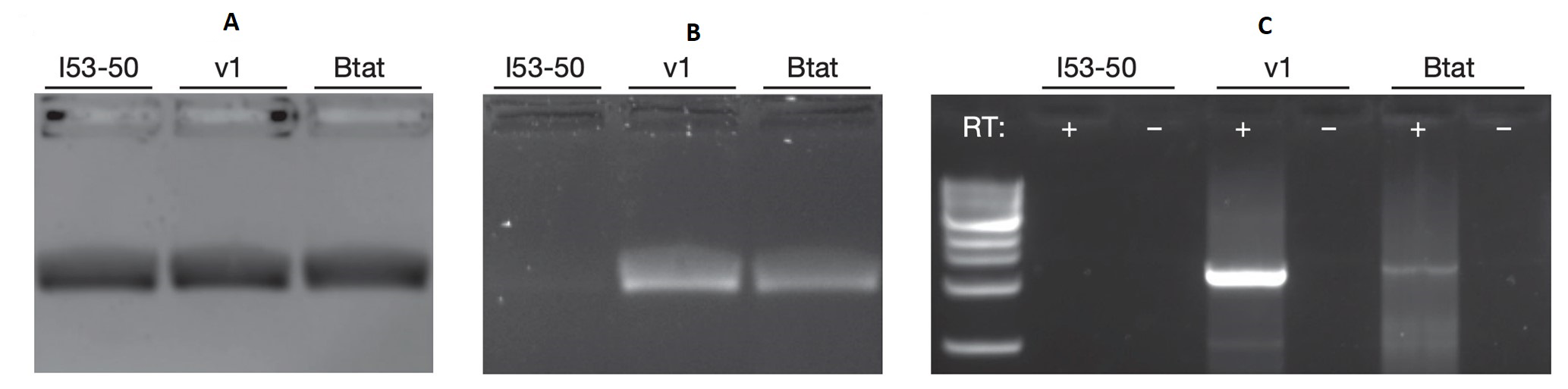 Figure 1. The first experiment. Nucleocapsids were purified and RNase and DNase enzymes were added. A) Protein content. B) After denaturation of the protein and addition of DNase, nucleic acid content. C) After denaturation of the proteins, nucleic acid content in the presence (+) and absence (−) of reverse transcriptase (RT). Highly diluted samples were used for RT-PCR.
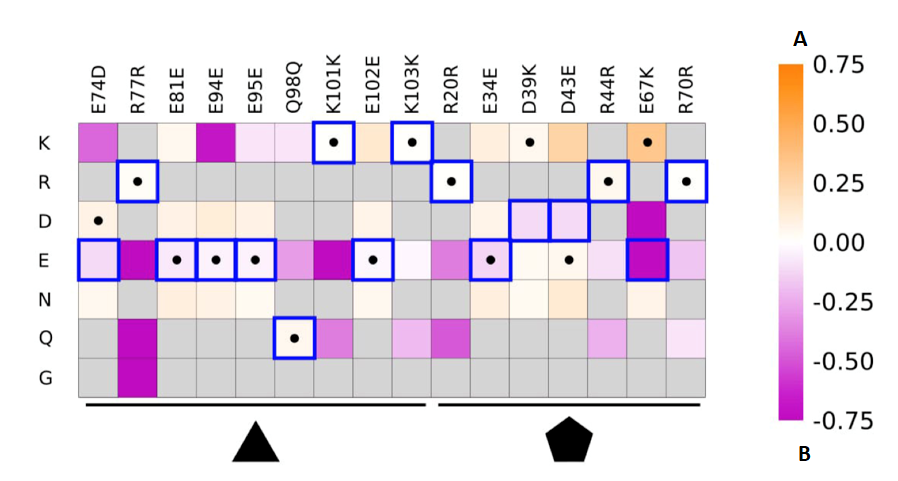 Figure 2. The second experiment. Heatmap of mutation effects on nucleic acid protection by the capsid. Each column is a site in the protein (triangle or pentagon subunit), each row is the substituted amino acid. Blue squares = I53-50-v1 starting sequence, black dots = I53-50-v2 selected sequence. Color scale: enriched (beneficial) to depleted (detrimental).
Question reproduced from IBO 2023, Theoretical Paper 1, licensed under CC BY-NC-SA 4.0 - attributed to the International Biology Olympiad. Open the full exam PDF